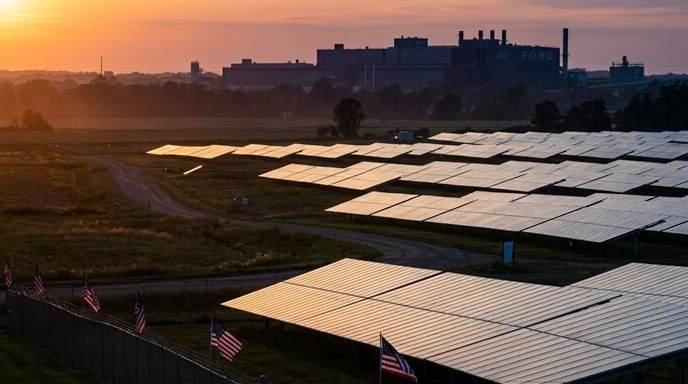
Ford Motor Company is putting serious money behind a large-scale solar project that will directly power several of its Michigan manufacturing plants. The company announced on October 7, 2026, that it is backing a 450-megawatt solar farm in Monroe County, just south of Detroit. The facility is expected to generate enough electricity to cover a significant portion of the energy needs at the Rouge Electric Vehicle Center, the Michigan Assembly Plant, and nearby supplier operations.
The project is being developed in partnership with a Michigan-based renewable energy firm and is backed by roughly $650 million in total investment, including Ford’s direct contribution and support through state and federal incentives under the Inflation Reduction Act. Construction is slated to begin in early 2027, with the first panels expected to come online by late 2028.
For Ford, this isn’t just another sustainability checkbox. Michigan’s industrial electricity rates have risen steadily over the past three years, driven by grid upgrades, extreme weather events, and surging demand from data centers and EV battery plants. By locking in its own on-site and nearby solar generation, Ford gains more control over long-term energy costs — a critical advantage when building vehicles like the F-150 Lightning, Mustang Mach-E, and the upcoming next-generation electric trucks and SUVs.
The solar farm will also help the company meet its aggressive internal targets for reducing Scope 1 and 2 emissions at its own facilities. Ford has committed to carbon-neutral manufacturing operations in North America by 2035, and this project represents one of the largest single steps toward that goal.
The announcement is landing particularly well in southeast Michigan. The solar farm is expected to create approximately 400 construction jobs during the build-out phase and 60–80 permanent positions for operations and maintenance once completed. Many of those roles are likely to go to local workers, including members of the United Auto Workers union, who have been pushing for more green manufacturing commitments in recent contract talks.
Monroe County officials have welcomed the project, noting that it will generate significant new property tax revenue while repurposing underutilized land. The site is located near existing transmission infrastructure, which should help keep interconnection costs down and speed up the timeline.
Unlike some competitors that rely heavily on purchasing renewable energy credits or signing virtual power purchase agreements, Ford is choosing to invest directly in generation assets close to its factories. This approach mirrors what the company has done with battery plants and assembly facilities — keeping more of the value chain in-house and in the U.S.

The solar farm will also be paired with battery storage at the plant sites, allowing Ford to shift solar power to peak manufacturing hours and provide backup during grid stress events. That combination is increasingly important as Michigan and other Midwest states face more frequent extreme weather that can knock out power for days.
For U.S. consumers, this kind of investment helps keep manufacturing costs more stable over time, which can translate into more competitive pricing on future electric vehicles. It also strengthens the case that American automakers can lead in both vehicle electrification and the clean energy infrastructure needed to support it.
For Michigan workers, the project reinforces that the state’s auto industry isn’t just surviving the transition to electric vehicles — it’s actively shaping the supporting energy ecosystem. The same communities that built America’s trucks and cars for generations are now also building the solar arrays and battery systems that will power the next generation of vehicles.
Ford has said it plans to expand similar renewable energy partnerships at other major U.S. sites in the coming years. The Monroe County solar farm is the largest single project announced so far, but it’s clearly meant to be a template rather than a one-off.
In an era when energy costs and supply-chain resilience matter as much as horsepower and range, Ford’s decision to back a major solar farm right in its own backyard makes practical business sense. For American manufacturing communities, it’s also a tangible sign that the future of the auto industry and the future of clean energy are being built in the same places — and often by the same workers.
Related Post