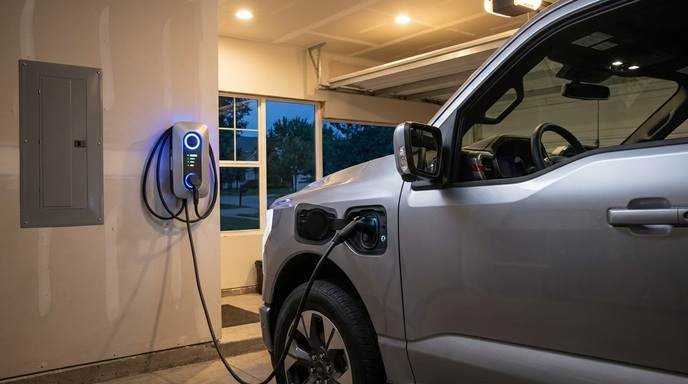
An F-150 Lightning charger on a 100 amp panel can work without a full service upgrade, but only if your home has enough remaining electrical capacity after existing loads are counted. A 100-amp service is not the same thing as 100 amps of free power for a truck. Many households can support a lower- or mid-rate Level 2 charger (often in the 24–40 amp range) with a proper load calculation. Others—especially all-electric homes with heavy HVAC, range, dryer, and water-heating loads—may need load management or a 200-amp upgrade. The safe path is not “install the biggest charger.” It is “match charger amperage to verified available capacity,” using equipment listed for EV charging and installation by a qualified, licensed electrician under local code and permitting rules.

Can an F-150 Lightning Charger Work on a 100-Amp Panel?
Yes, an F-150 Lightning can charge on a 100-amp panel when a load calculation shows enough spare capacity, usually at a moderate Level 2 rate rather than maximum home charging speed. Feasibility depends on existing household loads, continuous-load rules, charger amperage, and local electrical requirements—not the truck alone.
A 100-amp residential service means the main electrical service and panel are generally rated to supply up to 100 amps at the service voltage (commonly split-phase 120/240V in U.S. homes). It does not mean you have 100 amps sitting unused in the garage.
Your lights, HVAC, kitchen appliances, laundry equipment, water heating, and other branch circuits already claim part of that capacity. EV charging adds another large, long-duration load. Under typical U.S. electrical practice, EV chargers (EVSE) are treated as continuous loads (running for three hours or more), which affects circuit sizing and how much capacity you can responsibly assign.
Panel rating vs. available capacity
| Term | What it means for homeowners |
|---|---|
| Panel/service rating | Maximum the service equipment is designed to handle (e.g., 100A) |
| Connected loads | Everything that can draw power |
| Calculated demand | Code-based estimate of realistic simultaneous use |
| Available capacity | What remains for a new EV charger after calculation |
| Charger circuit size | Breaker/wire rating for the EVSE, including continuous-load sizing |
Two houses with “100-amp panels” can get opposite answers: one supports a 32-amp Lightning charge setup comfortably; the other is already near practical limits before the truck plugs in.
How Much Electrical Capacity Does an F-150 Lightning Charger Need?
Power is roughly:
Power (watts) ≈ Voltage × Current
At a nominal 240 volts:
| Charger current | Theoretical power | Notes |
|---|---|---|
| 24A | ~5.8 kW | Lower Level 2 rate |
| 32A | ~7.7 kW | Common moderate rate |
| 40A | ~9.6 kW | Faster Level 2 |
| 48A | ~11.5 kW | High residential Level 2 rate |
These are illustrative electrical numbers, not a promise of miles-per-hour in every Lightning configuration. Real charging power also depends on the EVSE rating, vehicle acceptance, battery size/state, temperature, and charging losses.
Because EV charging is generally continuous, circuit design commonly uses 125% sizing for the continuous current (for example, a 40A continuous charge level is typically associated with a 50A circuit design; a 48A continuous level with a 60A circuit). Exact breaker, conductor, and disconnect requirements must follow the EVSE instructions, National Electrical Code (NEC) requirements as adopted locally, and the electrician’s design—not a blog rule of thumb.
Ford’s home-charging ecosystem has included mobile charging options and dedicated Level 2 stations with different maximum rates depending on model and installation. Verify current Ford charge equipment ratings and installation instructions for the exact hardware you plan to use, rather than assuming every Lightning needs a 48A circuit.
What Charger Amperage Is Best for an F-150 Lightning on 100 Amps?
There is no single “best” amperage for every 100-amp home. The best choice is the highest rate your calculated capacity and installation can support safely—or a lower rate if overnight charging already covers your driving.
Can You Use a 24-Amp Charger on a 100-Amp Panel?
A 24-amp charge level is a modest Level 2 setup (~5.8 kW at 240V nominal).
Why it may fit: It adds a smaller continuous load, so it is often the easiest rate to justify on constrained services.
Why it may not: If you drive high daily miles or start from a very low state of charge, overnight recovery can feel slow.
Electric heat, older panels, or multiple large appliances still matter—even at 24A.
Can You Use a 32-Amp Charger on a 100-Amp Panel?
32-amp charging (~7.7 kW class at 240V nominal) is a practical middle ground for many Lightning owners who want real Level 2 speed without maximum circuit demand.
Why it may fit: Better overnight recovery than 24A; still lower demand than 40–48A.
Why it may not: Homes with electric range + dryer + central AC + water heat may still fail a load calculation.
Diversity of loads, climate (AC/heat duty), and whether charging happens while dinner appliances run.
Can You Use a 40-Amp Charger on a 100-Amp Panel?
40-amp charging (~9.6 kW class) is popular where capacity exists, often paired with a 50A-style circuit design because of continuous-load sizing.
Why it may fit: Strong overnight replenishment for many commute patterns.
Why it may not: On a busy 100A service, 40A continuous can be too aggressive without load management or reduced other demand.
Peak summer AC + cooking + laundry coinciding with plug-in time is a classic stress case.
Can You Use a 48-Amp Charger on a 100-Amp Panel?
48-amp charging (~11.5 kW class) is a high residential Level 2 rate and usually needs a 60A-class circuit design.
Why it may fit: Only when a load calculation shows clear spare capacity—or when dynamic load management is properly designed and allowed.
Why it may not: Many 100A homes simply do not have the headroom for a near-permanent ~48A continuous add-on plus existing peaks.
All-electric homes and dual-EV future plans often push this toward upgrade territory.
On 100A services, 24A–32A is frequently the more realistic conversation starter; 40A–48A is capacity-dependent, not entitlement-based.
F-150 Lightning 32-Amp vs. 40-Amp vs. 48-Amp Charging
| Charging current | Approx. power @ 240V (nominal) | Relative speed | Typical use case | 100A service considerations |
|---|---|---|---|---|
| 24A | ~5.8 kW | Baseline Level 2 | Low/moderate daily miles | Often easiest to accommodate |
| 32A | ~7.7 kW | Moderate | Most commute + errands | Common “sweet spot” candidate |
| 40A | ~9.6 kW | Faster | Higher daily miles | Needs stronger spare capacity |
| 48A | ~11.5 kW | Fast residential L2 | Max home convenience | Least likely without headroom or management |
The fastest charger is not automatically the best. If a 32A setup restores what you drive most nights, paying for a 48A install—or forcing a service upgrade—may buy speed you never use. Conversely, if you regularly deep-cycle a large Lightning battery pack, slow charging can become an operational headache.
For deeper product-level setup guidance, a dedicated F-150 Lightning home charging guide and F-150 Lightning charging speed explainer pair well with this service-capacity discussion.
How Fast Will an F-150 Lightning Charge on a 100-Amp Panel?
Charging speed depends on:
- EVSE output (amps/kW)
- Vehicle onboard acceptance and configuration
- Starting state of charge
- Battery temperature / thermal conditioning
- Charge curve (taper near full)
- AC charging losses
- Whether load management temporarily reduces power
Do not treat any blog math as a guaranteed miles-per-hour figure. The examples below are simplified energy estimates for planning conversations.
Rough energy math:
kWh added ≈ kW × hours × efficiency factor
(Using a conservative ~90% door-to-battery planning factor is common in homeowner estimates; real results vary.)
F-150 Lightning Charging at 24 Amps
~5.8 kW nominal. Over 8 hours, theoretical energy is on the order of ~46 kWh before losses; after losses, a planning figure might land lower. Useful for lower daily consumption; less ideal for big deficit recovery.
F-150 Lightning Charging at 32 Amps
~7.7 kW nominal. An 8-hour window can move a substantial amount of energy for many drivers—often the practical overnight workhorse rate on constrained services.
F-150 Lightning Charging at 40 Amps
~9.6 kW nominal. Noticeably stronger recovery overnight, if the electrical service and installation support it.
F-150 Lightning Charging at 48 Amps
~11.5 kW nominal. Among the stronger common home AC rates. Excellent when capacity exists; problematic when it does not.
Exact “miles added” varies with Lightning battery pack, drivetrain efficiency, weather, payload, and driving style. Ford publishes range and charging guidance by model year/configuration—use the truck’s current documentation and the EVSE rating for expectations, not a single universal chart.
Can You Charge an F-150 Lightning Overnight on a 100-Amp Service?
For many owners, yes—because the right question is not “Can I charge at maximum rate?” but “Can I replace what I used before I leave?”
Overnight Level 2 shines when:
- You plug in after arriving home
- The truck sits 6–10+ hours
- Daily miles are predictable
- You are not trying to rebound from near-empty to full every night
Maximum speed matters more for:
- Back-to-back long days
- Shared vehicles with short turnaround
- Frequent low-SOC returns
- No daytime workplace charging
How Many Miles Can an F-150 Lightning Add Overnight?
Use energy needed, not wishful miles.
Example only (not a personal electrical approval):
If your driving uses about 15–25 kWh/day, even a moderate Level 2 rate can often replace that overnight. If you regularly use 40–60+ kWh/day, you need either longer charge time, higher charge power, or midday top-ups.
A simplified planning approach:
- Estimate daily kWh (truck screens, trip logs, or utility/vehicle apps).
- Choose charge window hours.
- Compare required average kW to a candidate charger rate.
- Confirm the home can electrically support that rate.
This is operational planning—not a substitute for a load calculation.
What If Your 100-Amp Panel Already Powers a Dryer, Range, and HVAC?
This is where most “my neighbor did it” advice falls apart. Common large loads:
- Electric dryer
- Electric range / wall oven
- Central air conditioner
- Heat pump
- Electric furnace / strip heat
- Electric water heater
- Pool pump / heater
- Well pump
- Level 2 EV charger (new)
Why Existing Electrical Loads Matter
Utilities and electricians do not assume every appliance runs flat-out forever—but EV charging is long and steady. A 100A service that “works fine today” can still be a poor candidate for a large continuous add-on if peaks stack.
Can an F-150 Lightning Charger Operate Alongside Other Major Appliances?
Sometimes yes, sometimes no. Diversity helps (not everything peaks together). Continuous EV charging hurts (it does stay on).
Hypothetical example (educational only):
Imagine a 100A home where a demand calculation already sits near the practical ceiling because of electric range, dryer, water heater, and summer AC. Adding a 48A continuous EV load can be unrealistic. The same home might accommodate 24A or 32A, especially with off-peak charging habits—or might need load management so the charger automatically steps down when the HVAC and kitchen surge.
This is a teaching scenario, not your house’s assessment.
How to Determine Whether a 100-Amp Panel Can Handle an F-150 Lightning
Homeowners can gather information; a licensed electrician should perform the formal evaluation and design.
What a load calculation is trying to answer
- What is the service size?
- What major loads exist?
- What does code-style demand say about realistic simultaneous use?
- How much continuous EV load can be added?
- Does the chosen EVSE circuit still leave a safe margin under local rules and utility requirements?
100A × 240V ≈ 24 kW nominal
That does not mean you may assign 24 kW to a Lightning charger. Much of that capacity supports the house. The charger only gets the available portion after calculation—and circuit sizing still follows continuous-load and manufacturer rules.
- Main breaker and panel condition
- Bus rating
- Grounding/bonding condition
- Space for a correctly sized breaker
- Utility service conductor limitations (sometimes the bottleneck is not only the panel interior)
- Permit / inspection requirements
If you want a companion piece later, an EV charger on a 100-amp panel checklist article can walk through prep questions to ask before the electrician arrives.
Do You Need to Upgrade From 100 Amps to 200 Amps for an F-150 Lightning?
A 200-amp service is common and flexible, but it is not a universal Lightning requirement.
When a 200-Amp Service Upgrade May Make Sense
- Load calculation fails at useful charge rates
- Electric heating already dominates winter demand
- Multiple large appliances + EV
- Plans for two EVs
- Desire for sustained high-power Level 2 (or future electrification: induction, heat pump water heater, etc.)
- Panel age/condition makes modification a poor long-term bet
When You May Not Need a Panel Upgrade
- Calculation shows spare capacity at 24–40A (or another supported rate)
- Daily driving is covered by moderate overnight charging
- A listed load management solution is appropriate for the equipment and jurisdiction
- No near-term plan for stacking more large continuous loads
No article can guarantee your outcome without the home-specific numbers.
Can Load Management Avoid a 200-Amp Panel Upgrade?
Sometimes load management (including dynamic load management) is a practical alternative to immediate service upgrades.
Related ideas homeowners search for:
- F-150 Lightning load management
- EV charger load management 100 amp panel
- EV charger without panel upgrade
- Dynamic load management EV charger
How Dynamic Load Management Works
A managed system monitors whole-home current (often via CTs / meter interface) and reduces EV charging power when household demand rises, then restores charging power when demand falls. It does not create new capacity. It shares existing capacity more intelligently.
Is Load Management Safe for a 100-Amp Service?
It can be part of a code-compliant, listed, professionally designed solution. Safety depends on correct equipment selection, installation, configuration, and inspection—not the marketing phrase “no panel upgrade needed.”
Load Management vs. Panel Upgrade
| Approach | Pros | Cons |
|---|---|---|
| Load management | May avoid upgrade cost; protects service from overload | Charge rate can drop during home peaks; equipment complexity |
| 200A upgrade | More headroom; simpler high-rate charging future | Higher cost; construction time; permitting |
| Lower fixed charge rate | Simple; predictable | Slower recovery |
If you pursue this route, read manufacturer compatibility notes carefully and consider a dedicated EV charger load management guide for product categories and electrician questions.
What Breaker Size Does an F-150 Lightning Home Charger Need?
Desired charge current → continuous-load sizing → breaker & conductors → EVSE rating → service capacity
Examples commonly discussed in residential work (always confirm with EVSE instructions and local code):
What Size Breaker for a 32-Amp EV Charger?
A 32A continuous charge setting is commonly associated with a 40A branch-circuit design (125% rule of thumb for continuous loads). Wire gauge and installation method must match ampacity rules and conditions of use.
What Size Breaker for a 40-Amp EV Charger?
A 40A continuous level is commonly associated with a 50A circuit design.
What Size Breaker for a 48-Amp EV Charger?
A 48A continuous level is commonly associated with a 60A circuit design.
Breaker size is not a free upgrade knob. Conductors, terminals, EVSE rating, disconnect requirements, and heat dissipation all have to match. Oversizing a breaker on undersized wiring is dangerous.
NEMA 14-50 receptacle installations are a separate discussion (cord-and-plug vs hardwired, duty cycle, GFCI rules as adopted locally, and manufacturer guidance). If you use a receptacle form factor, see a dedicated F-150 Lightning NEMA 14-50 charging article and still hire qualified installation—receptacle quality and torque details matter more than people think.
Can You Install an F-150 Lightning Charger on a 100-Amp Subpanel?
A subpanel does not invent more power from the utility service. It only redistributes what the feeder and upstream service can supply.
- Main service still limited (e.g., 100A class)
- Feeder breaker/conductor size to the subpanel
- Subpanel bus rating
- Garage distance and voltage drop
- Indoor vs outdoor equipment ratings
- Whether the “100A subpanel” is already loaded with tools, HVAC equipment, or workshop circuits
F-150 Lightning Charger in a Detached Garage
Detached garages add practical complexity:
- Trenching/conduit pathways
- Feeder capacity and voltage drop over distance
- Local permitting
- Outdoor disconnect/emergency access rules as applicable
- Wi-Fi/app connectivity for smart chargers (convenience, not safety)
This is planning context—not a DIY wiring procedure. For project scoping, a future EV charger detached garage installation checklist can help homeowners prepare contractor bids.
F-150 Lightning Level 1 vs. Level 2 Charging on 100 Amps
| Factor | Level 1 (120V) | Level 2 (240V) |
|---|---|---|
| Voltage | ~120V | ~240V |
| Speed | Slow | Much faster |
| Installation complexity | Often uses existing receptacle (quality/condition matter) | Usually new circuit / EVSE |
| Typical use | Low daily miles, temporary | Primary home charging |
| Overnight practicality | Limited recovery | Usually practical |
| 100A impact | Smaller continuous load | Larger continuous load |
| Best for | Light commuting / stopgap | Most Lightning owners |
Level 1 can work for low-mileage drivers. Many Lightning owners still prefer Level 2 because trucks are heavy, aerodynamic loads vary, and weekly energy use can exceed what a 120V circuit comfortably restores.
F-150 Lightning Mobile Charger vs. Dedicated Home Level 2 Charger
| Factor | Mobile/portable EVSE | Dedicated wall Level 2 |
|---|---|---|
| Convenience | Travel flexibility | Best daily plug-in experience |
| Speed | Depends on adapter/circuit | Often higher sustained rate if wired for it |
| Electrical needs | Must match available outlet/circuit rating | Designed circuit for chosen amperage |
| 100A service fit | May allow lower-rate options | Choose rate based on load calc |
| Long-term daily use | Okay for some; not always ideal as permanent high-duty setup | Generally preferable for permanent home charging |
On a 100A service, a mobile unit on a moderate 240V circuit can be a rational compromise—if the receptacle/circuit are correctly installed for EV duty and the service calculation supports it. A hardwired dedicated station can be cleaner and more robust for daily use. Follow Ford and EVSE instructions for supported configurations.
What Happens If an F-150 Lightning Charger Draws Too Much Power?
Possible outcomes of an overloaded or misdesigned setup:
- Nuisance main/branch breaker trips
- Overheated terminations
- Stressed conductors or devices
- Voltage drop / dimming complaints
- Equipment damage risk
- Fire hazard in severe misuse or poor workmanship cases
Never “fix” trips by installing a larger breaker
If a breaker trips, it is performing a protective function. Installing a larger breaker without redesigning the entire circuit and confirming service capacity is unsafe and incorrect. The remedy is proper diagnosis: load calculation, correct EVSE settings, correctly sized conductors, healthy terminations, and possibly load management or service upgrades.
Signs Your 100-Amp Electrical System May Not Have Enough Capacity
Treat these as yellow flags, not a final verdict:
- Frequent breaker trips when several appliances run
- Electric resistance heating as primary heat
- Electric range + dryer + water heat + strong AC
- Panel already crowded / no clean space for a proper EV breaker
- Prior electrician notes about service limits
- Lights dipping when large loads start
- You want two high-power EVSE units soon
- Load calculation leaves little/no room for continuous EV charging
When flags stack, budget mentally for managed charging or a 200A upgrade path.
Range & Consumption Chart
| Item | Planning value |
|---|---|
| Energy use basis | AC kWh from wall ÷ miles |
| “Efficient mixed” | ~2.2 mi/kWh |
| “Typical mixed” | ~1.8 mi/kWh |
| “Highway / loaded / cold” | ~1.4 mi/kWh |
| Usable battery examples | Standard-range class ~90–100 kWh, Extended-range class ~125–135 kWh (approx. bands; confirm for model year) |
Range & Consumption Table (illustrative)
| Driving cycle | mi/kWh | kWh / 100 miles | Std-range pack est. range* | Ext-range pack est. range* |
|---|---|---|---|---|
| City / mild weather | 2.4 | 41.7 | 216–240 mi | 300–324 mi |
| Efficient mixed | 2.2 | 45.5 | 198–220 mi | 275–297 mi |
| Typical mixed | 1.8 | 55.6 | 162–180 mi | 225–243 mi |
| Highway 70–75 mph | 1.6 | 62.5 | 144–160 mi | 200–216 mi |
| Highway + wind/hills | 1.5 | 66.7 | 135–150 mi | 188–203 mi |
| Cold + cabin heat | 1.4 | 71.4 | 126–140 mi | 175–189 mi |
| Towing / heavy load | 1.0–1.2 | 83–100 | 90–120 mi | 125–162 mi |
Range & Charging Analysis
Responsive charts and tables for Level 2 rates (24A / 32A / 40A / 48A). Built for 100-amp panel planning discussions — desktop & mobile optimized.
Charge Rate Snapshot
Battery-side power at ~90% wall-to-battery efficiency. Hover or tap for details.
Energy Use by Driving Cycle
kWh consumed per 100 miles
Estimated Range by Pack
Standard ~95 kWh vs Extended ~130 kWh
Miles Added per Hour
By rate and driving efficiency
Hours to Add Energy
Target kWh vs. charging rate
Miles Added in 8 Hours
Typical overnight recovery by rate
Range Added / 10 Minutes
Quick top-up comparison
Level 2 Power vs. State of Charge
Illustrative flat L2 band with taper after ~90% SOC. Real-world curves depend on BMS thermal management.
0–100% Charge (130 kWh pack)
Hours from current SOC at each rate
← Swipe table to see all columns →
Power, Circuit & Cost
At $0.16/kWh average rate
| Metric | 24A | 32A | 40A | 48A |
|---|---|---|---|---|
| Wall power (kW) | 5.76 | 7.68 | 9.60 | 11.52 |
| Battery power est. | 5.2 | 6.9 | 8.6 | 10.4 |
| mi/hr @ 1.8 | 9.4 | 12.4 | 15.5 | 18.7 |
| mi/hr @ 1.5 | 7.8 | 10.4 | 12.9 | 15.6 |
| min / 10 mi @ 1.8 | 64 | 48 | 39 | 32 |
| Typical circuit | 30A | 40A | 50A | 60A |
| Cost/hr @ $0.16 | $0.92 | $1.23 | $1.54 | $1.84 |
| Share of 100A panel | 24% | 32% | 40% | 48% |
“Share of 100A” is raw math only — not spare capacity. Always consult an electrician.
mi/min by Driving Cycle
| Cycle | mi/kWh | 24A | 32A | 40A | 48A |
|---|---|---|---|---|---|
| City mild | 2.4 | 0.208 | 0.276 | 0.344 | 0.416 |
| Efficient mixed | 2.2 | 0.191 | 0.253 | 0.315 | 0.381 |
| Typical mixed | 1.8 | 0.156 | 0.207 | 0.258 | 0.312 |
| Highway | 1.6 | 0.139 | 0.184 | 0.229 | 0.277 |
| Cold weather | 1.4 | 0.121 | 0.161 | 0.201 | 0.243 |
| Towing / heavy | 1.1 | 0.095 | 0.127 | 0.158 | 0.191 |
8-Hour Charge Data
| Rate | kWh | @ 1.8 mi/kWh | @ 1.5 mi/kWh | @ 2.2 mi/kWh |
|---|---|---|---|---|
| 24A | ~41.6 | ~75 mi | ~62 mi | ~92 mi |
| 32A | ~55.2 | ~99 mi | ~83 mi | ~121 mi |
| 40A | ~68.8 | ~124 mi | ~103 mi | ~151 mi |
| 48A | ~83.2 | ~150 mi | ~125 mi | ~183 mi |
Full Range & Consumption by Cycle
Estimated usable capacity: Std ~95 kWh · Ext ~130 kWh
| Driving cycle | mi/kWh | kWh/100 mi | Std pack (~95 kWh) | Ext pack (~130 kWh) |
|---|---|---|---|---|
| City / mild | 2.4 | 41.7 | 228 mi | 312 mi |
| Efficient mixed | 2.2 | 45.5 | 209 mi | 286 mi |
| Typical mixed | 1.8 | 55.6 | 171 mi | 234 mi |
| Highway 70–75 | 1.6 | 62.5 | 152 mi | 208 mi |
| Highway + wind/hills | 1.5 | 66.7 | 143 mi | 195 mi |
| Cold + cabin heat | 1.4 | 71.4 | 133 mi | 182 mi |
| Towing / heavy | 1.1 | 90.9 | 105 mi | 143 mi |
← Swipe to see full table →
Hours to Add Energy by Rate
| Energy added | 24A | 32A | 40A | 48A |
|---|---|---|---|---|
| 10 kWh | 1.9 h | 1.4 h | 1.2 h | 1.0 h |
| 20 kWh | 3.8 h | 2.9 h | 2.3 h | 1.9 h |
| 30 kWh | 5.8 h | 4.3 h | 3.5 h | 2.9 h |
| 40 kWh | 7.7 h | 5.8 h | 4.7 h | 3.8 h |
| 50 kWh | 9.6 h | 7.2 h | 5.8 h | 4.8 h |
| 60 kWh | 11.5 h | 8.7 h | 7.0 h | 5.8 h |
| 70 kWh | 13.5 h | 10.1 h | 8.1 h | 6.7 h |
| 80 kWh | 15.4 h | 11.6 h | 9.3 h | 7.7 h |
How Much Does F-150 Lightning Charger Installation Cost on a 100-Amp Panel?
There is no honest single national price. U.S. costs vary by region, labor rates, panel condition, trench distance, permit fees, and whether a service upgrade is required.
Cost drivers typically include:
- EVSE hardware (mobile vs connected wall unit)
- Breaker and wire
- Labor time
- Permit/inspection
- Panel modifications
- Load management hardware
- Garage distance / trenching
- Optional service upgrade to 200A
- Utility requirements / possible transformer or meter-side constraints (less common, but real)
Homeowners often see a wide bid range: a straightforward near-panel circuit is one project type; a full service upgrade plus long garage run is another entirely. Get multiple written bids from licensed electricians experienced with EVSE installs. For budgeting context, pair this with a F-150 Lightning charging cost ownership article (hardware + electricity + installation).
100-Amp Panel vs. 200-Amp Panel for F-150 Lightning
| Factor | 100-Amp Service | 200-Amp Service |
|---|---|---|
| Available capacity | Often tight after house loads | Generally more headroom |
| EV charging flexibility | Favor moderate rates / management | Wider choice of charge rates |
| High-power charging | May be limited | Easier to support |
| Two EVs | Difficult without careful management/scheduling | More realistic |
| Future electrical demand | Limited electrification runway | Better for all-electric futures |
| Upgrade need | Possible depending on calculation | Often already sufficient |
200A is not morally “better.” It is more flexible. If your calculated needs are modest, a well-designed 100A solution can be perfectly appropriate.
Can You Charge an F-150 Lightning and Another EV on a 100-Amp Panel?
Dual EV households push 100A services hard.
Examples:
- F-150 Lightning + Tesla Model Y
- F-150 Lightning + Mustang Mach-E
- F-150 Lightning + Ioniq 5
Options that professionals evaluate:
- Two lower-rate circuits (still may fail calculation)
- One shared managed system sharing a capacity ceiling
- Scheduled charging (different time windows)
- Workplace/top-up charging to reduce home demand
- Service upgrade
EVSE circuit sharing must be done with listed load-sharing equipment and proper design. A future piece on two EV chargers on one electrical panel can cover architectures without encouraging unsafe DIY.
Best Charging Strategy for an F-150 Lightning With a 100-Amp Panel
Situation 1: Lower household electrical demand
If the load calculation shows comfortable spare capacity, a moderate fixed Level 2 rate (often 32A-class, sometimes 40A-class) may be appropriate.
Situation 2: Moderate household electrical demand
Prefer 24–32A, off-peak charging, and possibly dynamic load management if peaks coincide with plug-in time.
Situation 3: High household electrical demand
Treat high-rate EVSE as unlikely. Prioritize formal calculation; expect management equipment or a 200A conversation—especially with electric heat.
Situation 4: Two EVs
Assume you need scheduled charging, managed sharing, or more service capacity. Do not stack maximum rates and hope.
Before buying a charger based on max kW marketing, pay for a licensed electrician’s load calculation and install quote. That single step prevents the two most expensive mistakes: underpowered disappointment and unsafe oversubscription.
FAQ/ Frequently Asked Questions
1. Can an F-150 Lightning charge on a 100-amp panel?
Yes—if available capacity supports the chosen charge rate after a proper electrical load calculation and compliant installation.
2. Does an F-150 Lightning require a 200-amp panel?
No. Many installs work on existing services at moderate Level 2 rates. High existing loads or dual-EV plans may justify 200A.
3. Can I install a 48-amp charger on a 100-amp service?
Only if capacity and design allow it. On many 100A homes, 48A continuous is too aggressive without management or upgrade.
4. Can I use a 40-amp charger on a 100-amp panel?
Possibly, capacity-dependent. It needs a correct circuit design (commonly 50A-class for 40A continuous) and spare service room.
5. Can I charge an F-150 Lightning overnight on 100 amps?
Often yes at moderate Level 2 power, if overnight hours cover your daily kWh use.
6. What size breaker does an F-150 Lightning charger need?
It depends on charge current and EVSE instructions. Examples: 32A continuous often aligns with 40A circuit design; 40A with 50A; 48A with 60A—confirm locally.
7. Can I use a NEMA 14-50 outlet for an F-150 Lightning?
Many owners do with compatible mobile/EVSE setups, but the receptacle circuit must be correctly installed for the load and local code. Quality installation matters.
8. Can load management prevent a panel upgrade?
Sometimes. It helps share existing capacity; it does not create new capacity and must be listed/compatible/professionally configured.
9. Can I charge two EVs on a 100-amp service?
It is difficult and highly conditional. Expect managed sharing, lower rates, scheduling, or a service upgrade.
10. How much does F-150 Lightning home charger installation cost?
Wide U.S. range depending on run length, panel work, permits, load management, and whether a service upgrade is required. Get local licensed bids.
11. Can I install an F-150 Lightning charger in a detached garage?
Yes, with proper feeder capacity, installation methods, and permits. Distance and voltage drop become major design factors.
12. What happens if my 100-amp panel is already heavily loaded?
A large EV adder may be unsafe/impractical. Options include lower charge rate, load management, reducing other loads, or upgrading service.
So, can you charge an F-150 Lightning on a 100-amp panel?
Often yes—at the right amperage, with the right design. A 100-amp service does not automatically block home charging, and it does not automatically approve a 48-amp wall unit either. What matters is available capacity after household demand, continuous-load circuit sizing, EVSE ratings, and local code/permit requirements.
If your daily driving can be restored overnight, a moderate Level 2 rate is frequently the smartest F-150 Lightning charger on a 100 amp panel strategy. If your home is already electrically busy, dynamic load management may help avoid an immediate upgrade by throttling the truck when the house peaks. If you want high-rate charging, multiple EVs, or major electrification soon, a 200-amp service can be the cleaner long-term answer.
Do not size this from internet anecdotes. Have a licensed electrician run a load calculation, propose a compliant EVSE circuit (or managed system), and price the real scope—including any utility or panel constraints. That is how you get convenient Lightning charging without turning your service equipment into the weak link.
Related post