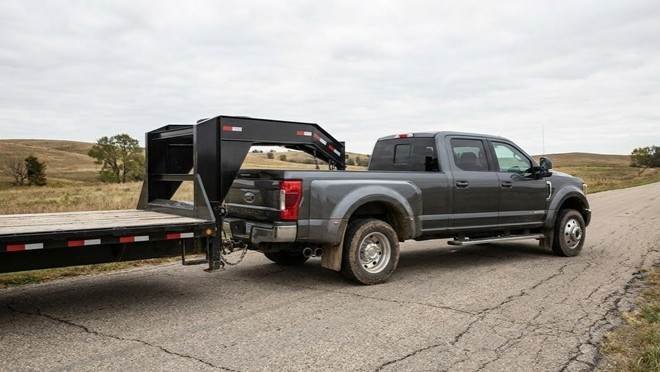
The 2027 F450 is not a one-rating vehicle. It is a dual-rear-wheel Super Duty whose legal, safe trailer limit changes with cab, bed, drivetrain, axle, hitch type, payload, and how the trailer is actually loaded. Ford’s headline figure is a ceiling for qualifying trucks. It is not a promise that the F-450 on a dealer pad, or the one in a used listing, can pull that weight with your fifth-wheel, gooseneck, or bumper-pull trailer.
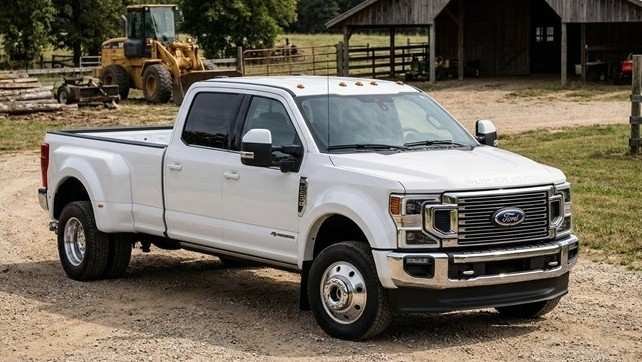
This guide is about what those numbers mean. Not the brochure max. The configuration, the hitch, the pin weight, and the combined rating that decide whether the truck is the right tool or just a very expensive way to overload a rear axle.
Before you tow anything, match the exact truck to Ford’s model-year towing selector, the door-jamb labels, and the trailer’s true loaded weight. Ratings can change by year and by build. If a 2027 figure is not on the window sticker or in Ford’s current towing guide, do not assume last year’s chart still applies.
2027 F450 Towing Capacity at a Glance
Ford’s current-generation F-450 Super Duty pickup has been built around a single heavy-duty idea: diesel torque, dual rear wheels, and gooseneck/fifth-wheel work that sits above an F-350. The consumer pickup has typically been a Crew Cab, long-bed, DRW truck with 4×2 or 4×4. Chassis Cab F-450s are a different product, meant for bodies and upfits, with their own ratings.
Use this table as a map of maximum published ratings in the current Super Duty generation, not as a guarantee for every 2027 F-450.
| Category | What buyers should understand |
|---|---|
| Maximum gooseneck towing | The headline number. Recently published at up to 40,000 lbs on qualifying F-450 configs. Not every truck, hitch, or axle setup. |
| Maximum fifth-wheel towing | Often near the gooseneck ceiling on the right build, still limited by pin weight, payload, and rear-axle rating. |
| Maximum conventional towing | Substantially lower than gooseneck/fifth-wheel. The receiver and tongue-weight rules, not the diesel, are usually the limiter. |
| Maximum payload | Separate from towing. Passengers, fuel, hitch hardware, and pin/tongue weight all count against it. |
| Engine | Current-gen F-450 pickup: 6.7-liter High-Output Power Stroke diesel V8. Confirm 2027 output on the sticker. |
| Recent HO diesel output | 500 hp / 1,200 lb-ft in the latest published Super Duty specs. Verify for 2027. |
| Transmission | TorqShift 10-speed automatic in the current generation. |
| Drivetrain | 4×2 or 4×4. 4×4 adds weight and can change remaining payload. |
| Rear axle | Dual rear wheels; F-450 pickup GVWR has typically been in the 14,000-lb class. |
Those are maximums and typical architecture, not a VIN-specific chart. Two F-450s can share a badge and not share a trailer rating. Download Ford’s official 2027 Super Duty / RV & Trailer Towing information for the cab, box, axle, and hitch you are actually buying.
Why 2027 F450 Towing Capacity Changes by Configuration
There is no universal 2027 F450 towing number because Ford does not certify “an F-450.” It certifies a truck: this cab, this wheelbase, this driveline, this axle ratio, this equipment, this GVWR. Change one of those and the remaining capacity on the tires, springs, hitch, and combined-weight rating can change with it.
Cab Configuration
On the F-450 pickup, recent U.S. availability has been Crew Cab, not a full Regular Cab / SuperCab pickup menu. That matters. Do not shop a Regular Cab F-450 towing chart if you are looking at a Crew Cab pickup, and do not assume a Chassis Cab rating applies to a pickup.
Cab choice still matters on the Chassis Cab side, and it still matters indirectly on the pickup: a Crew Cab is more truck to haul around. More steel, glass, seats, and sound deadening mean more curb weight. More curb weight means less leftover payload inside the same GVWR. Less leftover payload means less room for pin weight, passengers, and fuel before you are overweight—even if the trailer is under the published max.
If you need a Regular Cab or SuperCab F-450, you are usually in Chassis Cab territory, where the body you add (dump, flatbed, service body) becomes part of the weight math. The incomplete-vehicle rating and the final upfitter’s certification, not a pickup towing meme, govern that truck.
Bed Length and Wheelbase
Wheelbase is not a styling option on a gooseneck truck. It is the distance that decides how the trailer sits, how the truck turns, and how load is carried between the axles.
A longer wheelbase generally helps heavy fifth-wheel and gooseneck stability at speed. It can also make the truck harder to park, slower to turn into a jobsite, and more of a handful in a city fuel station. Bed length on an F-450 pickup is typically the long box, which is what you want for a bed-mounted hitch with decent cab clearance. Too little clearance between cab and trailer head is a real-world problem that no towing chart will fix.
Maneuverability and rating are not the same thing. A configuration can be rated to a high number and still be the wrong truck if you cannot swing the combination out of a ranch gate.
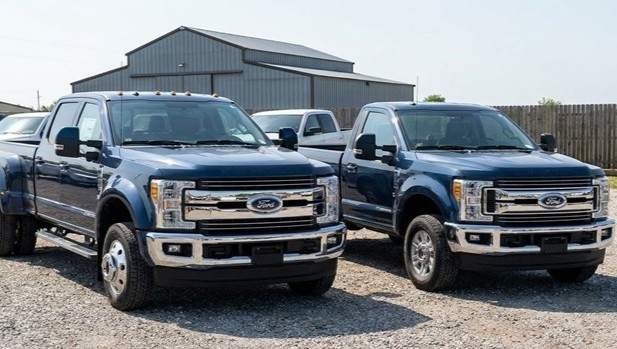
4×2 vs. 4×4
Four-wheel drive adds hardware: transfer case, front axle components, extra driveline mass. That extra weight usually comes out of payload. It can also show up as a different line on a towing table.
Do not assume 4×4 automatically tows less, or that 4×2 automatically tows more, unless the Ford chart for that exact 2027 configuration says so. What you can assume is this: if you buy 4×4 for mud, snow, or unpaved sites, you should re-check payload after you add people, a headache rack, and a hitch. The drivetrain you wanted for traction is part of the load the springs are already carrying.
Axle Ratio
Axle ratio is the gearing between the driveshaft and the wheels. A numerically higher ratio (for example 4.30 versus 3.31) multiplies torque more aggressively. The truck feels stronger off the line and on a grade. The engine also spins faster at a given highway speed, which can matter for heat, rpm, and how the diesel lives on a long pull.
Ford does not put every axle in every F-450. Heavy DRW trucks often use a deep ratio because the job is low-speed, high-load work, not empty highway cruising. The ratio on the window sticker is one of the reasons two diesels with the same horsepower rating do not pull the same. If you are comparing trucks, read the axle code, not just “Power Stroke.”
Towing Equipment
A rating assumes the right hardware exists and is used. Factory integrated trailer brake controller, the correct hitch, adequate trailer brakes, cooling, tires and wheels at the required load range, and functioning lights are not extras in this class. They are how the truck was certified.
Aftermarket hitches, the wrong ball, a gooseneck that is not framed to the truck’s intended attachment points, or trailer brakes that are too small will not “inherit” Ford’s maximum number. Tires matter as much as the engine. If the rubber cannot carry the axle’s share of pin weight plus cargo, the brochure GCWR is irrelevant.
2027 F450 Engine and Powertrain for Heavy Towing
The current-generation F-450 pickup has been offered with Ford’s 6.7-liter High-Output Power Stroke diesel V8, recently published at 500 horsepower and 1,200 lb-ft of torque, paired with a 10-speed TorqShift automatic. Confirm those figures on the 2027 window sticker and Ford’s official specs. Diesel output and transmission calibration can change by model year even when the badge stays the same.
Horsepower is how much work the engine can do in a given amount of time. Torque is the twisting force that gets a loaded trailer moving and keeps it moving on a grade. For a 2027 F450 diesel, torque is the specification that matches the job. You feel it when the combination leaves a stop, when you hook a fifth-wheel on an on-ramp, and when the road tilts up with a full gooseneck behind you.
A turbo diesel makes that twist down in the rev range, which is why these trucks can pull hard without screaming. The 10-speed’s job is to keep the engine in the part of the curve where that torque is actually available, then hold a gear on a grade instead of hunting. Engine braking and exhaust braking (when equipped and used correctly) matter on the way down as much as power matters on the way up. A heavy trailer that can be accelerated must also be slowed without cooking the service brakes.
None of that makes the F-450 “unstoppable.” Heat, altitude, trailer brakes, and a driver who ignores payload will still win. The 6.7 Power Stroke is the reason the truck can be rated where it is. It is not a substitute for reading the labels.
There is typically no gas V8 F-450 pickup in this role. If you need gasoline simplicity, you are usually shopping a different Super Duty, not this one.
2027 F450 Gooseneck Towing Capacity
Gooseneck towing is why a lot of people pay F-450 money.
A gooseneck trailer couples in the bed, over or near the rear axle, with a ball mounted to the frame. Compared with a bumper hitch, more of the trailer’s downward load is carried as pin weight in a place the truck was designed to take it. That is why Ford’s maximum 2027 F450 gooseneck towing capacity—up to 40,000 pounds on qualifying current-generation configurations—sits far above conventional towing. It is also why that number disappears if the hitch, tires, payload, or GCWR are wrong.
Pin weight is not optional math. A common range for gooseneck pin weight is roughly 15 to 25 percent of trailer weight, depending on how the trailer is loaded. On a 30,000-pound loaded gooseneck, 20 percent pin weight is 6,000 pounds on the truck before you add the hitch, passengers, diesel fuel, a toolbox, and a dog. If the truck’s remaining payload is 5,200 pounds, you are done. The trailer can still be “under 40,000.” The truck is still overloaded.
Rear-axle capacity (GAWR) is the next trap. Dual rear wheels spread the load, but they do not invent extra pounds above the axle rating. A gooseneck that is legal on paper and stacked too far aft on the trailer deck can still hammer the rear axle.
Hitch installation is not a YouTube accessory. The ball and frame attachments have to match the truck’s intended gooseneck provision. Trailer brakes have to be sized for the loaded trailer, connected, and adjusted. A 40,000-pound rating with weak trailer brakes is a physics problem, not a Ford problem.
Example (not an official Ford rating): A contractor sees “40,000-lb gooseneck” and buys a 36,000-pound equipment trailer because it is under the max. Loaded with a machine, ramps, and fuel, the trailer weighs 34,800. Pin weight is 6,400. The F-450 still has four adults, a full tank, and a headache rack. Payload is gone. The truck was never supposed to tow that combination, even though 34,800 is less than 40,000.
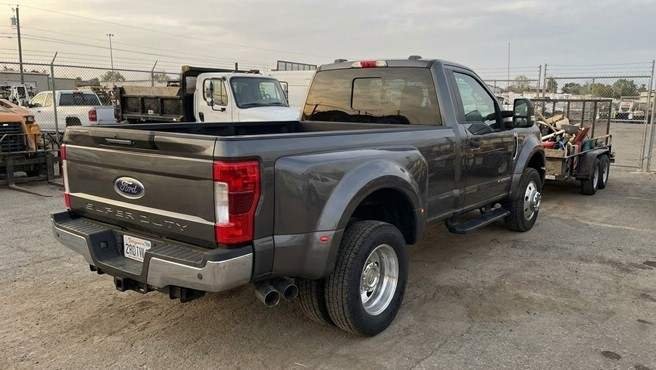
2027 F450 Fifth-Wheel Towing Capacity
Fifth-wheel towing is the RV version of the same idea: a hitch in the bed, load over the rear axle, stability at speed that a bumper pull cannot match at this weight.
Ford’s maximum fifth-wheel number on qualifying F-450 builds has lived in the same neighborhood as gooseneck in the current generation, with the same rule: configuration-specific, not universal. Hitch placement, cab clearance, and pin weight decide whether a big fifth-wheel is a good match or a slow-motion overload.
Pin weight on a fifth-wheel often lands around 15 to 25 percent of loaded trailer weight. That weight is payload. It is not “trailer weight that the truck doesn’t feel.”
A practical example: a 20,000-pound fifth-wheel does not mean the truck carries zero extra. At 20 percent pin weight, the truck is already carrying about 4,000 pounds in the bed area—plus the hitch, which can be hundreds of pounds by itself. Add two people, water, fuel in the truck, and camping gear in the bed or back seat. You can be at payload on a trailer that is nowhere near the F-450’s maximum fifth-wheel towing capacity.
Long-distance RV towing adds heat, mountain grades, and crosswinds. The rating says the combination is allowed. It does not say the driver will like the brakes, the mirrors, or the fuel stops. Trailer brakes are mandatory at these weights. A 360-degree or hitch camera helps you see the pin and the corners. Neither replaces weighing the combination at a certified scale.
2027 F450 Conventional Towing Capacity
Conventional towing means a receiver at the back of the truck: ball mount or pintle, tongue weight on the bumper structure, trailer behind the rear overhang.
This is where buyers get confused. The 2027 F450 maximum towing number in ads is almost never the conventional number. Gooseneck and fifth-wheel use the bed and the frame. A rear receiver is a different mechanical system with a lower ceiling.
Ford’s conventional rating for F-450 has been much lower than 40,000 pounds in the current generation—often in a band where a heavy bumper-pull is possible, but the “max tow” headline is not. Read the conventional column. Do not borrow the gooseneck figure.
Tongue weight on a conventional trailer is commonly around 10 to 15 percent of trailer weight. That still counts as payload. At extreme trailer weights, conventional towing also gets twitchy: more leverage behind the axle, more sway risk, more demand on the hitch and the rear of the frame. Weight-distributing hitches are a conversation for some bumper-pull setups; they are not a magic way to turn an F-450 into a 40,000-pound conventional truck.
If your trailer is a gooseneck or fifth-wheel, shop those columns. If it is a bumper-pull equipment trailer, shop conventional capacity, tongue weight, and whether you should have bought a different trailer in the first place.
2027 F450 Towing Capacity vs Payload Capacity
Towing capacity is how much trailer the truck is rated to pull.
Payload capacity is how much weight the truck itself can carry.
Payload includes people, pets, fuel, tools, bed cargo, aftermarket bumpers, the hitch, and the downward force from the trailer (tongue weight, fifth-wheel pin weight, or gooseneck pin weight). Ignore payload and the towing chart becomes fiction.
This is the section that saves F-450 buyers from a bad purchase.
A truck can be rated to pull a huge gooseneck and still run out of payload first. GVWR is the maximum allowed weight of the loaded truck, not including the trailer’s full weight, but including everything on the truck—pin/tongue included. If curb weight plus people plus hitch plus pin weight exceeds GVWR, you are over even if the trailer is under the max tow rating.
Example (illustrative math, not a Ford payload spec for a named 2027 VIN):
- Trailer loaded weight: 28,000 lbs
- Pin weight at 20%: 5,600 lbs
- Hitch: 80 lbs
- Two adults: 400 lbs
- Fuel and leftover bed cargo: 500 lbs
- Combined on-truck load from this list: 6,580 lbs
If that truck’s payload is 5,900 lbs, the combination is overweight before you discuss whether 28,000 is under a 40,000-lb gooseneck max. The max towing number did not fail you. The payload math did.
Do not invent a payload for a truck you have not seen. Payload is on the driver’s door-jamb tire/weight label and varies with 4×4, cab, options, and equipment. Two 2027 Ford F-450 stickers can differ by hundreds of pounds. That difference is a passenger, or the hitch, or the reason you cannot load the trailer the way the dealer sketched on a napkin.
What GCWR Means on the 2027 F450
GCWR (Gross Combined Weight Rating) is the maximum allowed weight of the truck and trailer together, as loaded and operated.
Truck + people + cargo + hitch + fuel + loaded trailer should not exceed GCWR.
The related labels, in plain language:
- GVWR: max weight of the loaded truck (including pin/tongue weight on the truck).
- GCWR: max weight of truck and trailer combined.
- GAWR: max weight on one axle (front or rear). Dual-rear-wheel trucks still have a rear GAWR.
- Payload: GVWR minus curb weight (what you can add to the empty truck).
- Curb weight: truck as it sits, without your people and cargo. Options change it.
- Trailer GVWR: the trailer manufacturer’s max loaded trailer weight. Your trailer can be below its own GVWR and still be too much for this truck.
First-time heavy-duty buyers get stuck because they only compare trailer GVWR to the truck’s max tow number. You have to clear all of it: trailer actual weight, pin/tongue, payload, GVWR, GAWR, GCWR, and tire load ratings.
If GCWR is 43,000 pounds and the loaded truck already weighs 9,500, the trailer side of the equation is not 40,000. It is 33,500, before you even talk hitch type. That is why a 2027 F450 GCWR line on a chart can matter more than the marketing towing number.
How to Read a 2027 F450 Towing Chart
Use Ford’s chart for the model year on the title. Do not use a screenshot from a forum.
- Identify the cab (for the pickup, that is typically Crew Cab).
- Identify 4×2 or 4×4.
- Identify the engine (HO 6.7 Power Stroke on the current F-450 pickup).
- Identify wheelbase and bed.
- Identify axle ratio on the window sticker.
- Identify hitch type: conventional, fifth-wheel, or gooseneck.
- Read that row only.
- Check the truck’s payload on the door label, not on an ad.
- Weigh or honestly calculate the trailer loaded, not empty brochure weight.
- Calculate tongue or pin weight.
- Confirm GVWR, GAWR, GCWR, and tire ratings.
- If any one number fails, the combination fails.
A generic “2027 F450 towing chart” on the internet is a starting point. The factory selector and the labels on the truck are the authority.
2027 F450 Towing Examples for Real-World Buyers
These are examples of how to think, not Ford ratings for a specific VIN.
Example 1: Heavy equipment trailer
A loaded equipment gooseneck at 26,000–32,000 pounds is exactly why people shop an F-450 instead of a half-ton. Check gooseneck capacity, pin weight, rear GAWR, trailer brakes, and whether the ramps and machine sit where the pin weight stays reasonable. If the machine is a concentrated load at the rear of the trailer, pin weight can go the wrong direction. The diesel will pull it. The axle label may not allow it.
Example 2: Large fifth-wheel RV
A 15,000–20,000-pound fifth-wheel is not automatically “easy” for an F-450. Pin weight plus hitch plus passengers plus freshwater plans have ended more RV purchases than horsepower has. Weigh the trailer loaded as you travel. If payload is tight, the answer is a lighter fifth-wheel or a different truck, not airbags and optimism.
Example 3: Heavy gooseneck
Near the published maximum, everything has to be right: hitch, tires, brakes, GCWR, and a driver who has towed heavy before. This is commercial territory. If you will live at 90 percent of the chart, budget for tires, brakes, and cooling-system care, and do not skip scales.
Example 4: Conventional trailer
A 16,000-pound bumper-pull can be more demanding on the hitch end than a heavier gooseneck is on the bed. Compare conventional capacity, tongue weight, and sway. Do not use the 40,000-pound gooseneck headline to justify a bumper-pull that belongs on a different column of the chart.
Is the 2027 F450 Overkill for Most Drivers?
Yes, for most drivers. You do not need an F-450 for a small travel trailer, a utility trailer with a mower, commuting, or occasional 5,000-pound recreational towing. An F-150, F-250, or even a well-spec’d F-350 will be easier to park, cheaper to tire, and less truck than you use. Ride quality, width, dual-rear-wheel tracking, fuel cost, and the turning circle are daily taxes you pay for a rating you may never touch.
The 2027 Ford F-450 starts to make sense when the trailer is heavy, the hitch is in the bed, and you do it often: equipment operators, commercial haulers, farmers and ranchers, contractors with goosenecks, and owners of large fifth-wheels who have already run the payload math. Frequent long-distance heavy towing is the use case. A once-a-year trailer is not.
Size is not theoretical. DRW trucks fill lanes, fuel bays, and driveways. Tires are expensive and must be matched. None of that is a reason to avoid the truck if you need it. It is a reason not to buy it as a lifestyle badge.
2027 F450 vs F350 for Heavy Towing
The F-350 is the volume heavy-duty Super Duty. The F-450 pickup is the step above: dual rear wheels as standard architecture, higher GVWR class, and a towing ceiling aimed at gooseneck work the F-350 may not be certified to match in the same way.
| Question | How to think about it |
|---|---|
| Towing ceiling | F-450’s published max gooseneck has sat above F-350. That only matters if your loaded trailer needs it. |
| Payload / rear axle | F-450’s higher GVWR and DRW setup are about carrying pin weight, not winning a brochure fight. |
| Daily driving | F-350 SRW is easier to live with. F-450 is wider and more truck. |
| Cost | You pay more to buy, tire, and fuel an F-450. Worth it only if the load requires it. |
| RV towing | Many fifth-wheels fit an F-350 if pin weight and GCWR clear. Step up when they don’t. |
| Commercial | If the trailer is a heavy gooseneck as a business tool, F-450 is the conversation. |
When does it make sense to step up from an F-350 to an F-450? When the loaded trailer, hitch type, pin weight, and combined ratings do not fit a correctly spec’d F-350—including dual-rear-wheel F-350s, which are not the same truck as an F-450. If an F-350 DRW already covers the trailer with margin, the F-450 is not automatically better. It is more capacity you may not use.
What the 2027 F450’s Maximum Towing Number Doesn’t Tell You
A maximum towing figure does not describe the road. It does not tell you how the trailer is loaded, whether the pin is 15 percent or 25 percent, whether you are in 95-degree heat at altitude, whether the tires are at the correct pressure, or whether the person behind the wheel has ever backed a 35-foot gooseneck. It does not include a wet boat ramp, a 6 percent mountain grade, or a crosswind on an empty high-sided trailer.
Rated to tow a weight means the manufacturer certified that configuration for that trailer weight under its test and labeling rules. Towing that weight comfortably and responsibly is a different sentence. Maintenance, trailer brakes, weight distribution, and driver experience sit outside the chart. The number is a limit, not a recommendation to live at the limit.
2027 F450 Towing Technology and Driver Assistance
Late Super Duty trucks have piled on cameras and assists. Treat them as configuration-dependent, not standard on every 2027 F450.
Depending on series and options, Ford has offered integrated trailer brake controllers, trailer light checks, multiple cameras, Trailer Reverse Guidance, Pro Trailer Backup Assist on some setups, and blind-spot systems that can account for a trailer. Onboard scale or smart-hitch related features have appeared in Ford’s heavy-duty ecosystem as available technology—not as something you assume is on an XL work truck.
None of it is a substitute for a brake controller that is hooked up, a hitch that is rated, and a scale ticket. Cameras help you see the ball. They do not add payload. Confirm what is on the window sticker. Do not copy a Platinum brochure onto a base 4×2.
2027 F450 Towing and Long-Term Ownership
If you operate near maximum towing capacity, you are in a different ownership category than someone who tows a landscape trailer twice a summer.
Diesel care is the job: oil and filter at the severe-service end of Ford’s schedule if you tow heavy, fuel filters, DEF on the Power Stroke, and cooling-system health. Do not invent intervals here—use the 2027 owner’s manual and the severe-duty chart if you pull weight in heat or dirt.
Tires and brakes are consumables at this GVWR. Heavy pin weight cooks rear brakes if the trailer brakes are lazy. Transmission service follows Ford’s guidance, not a chain-lube upsell. Suspension components and hitch hardware should be inspected, not assumed. The trailer itself needs bearings, brakes, and tires; a perfect F-450 cannot fix a neglected gooseneck.
Someone who regularly runs near the chart should take maintenance more seriously because heat and load stack. That is not a scare line. It is how heavy trucks are used.
Frequently Asked Questions
How much can the 2027 F450 tow?
It depends on configuration and hitch. In the current Super Duty generation, qualifying F-450s have been published at up to 40,000 pounds gooseneck. Conventional towing is much lower. Confirm the exact 2027 row for cab, 4×2/4×4, axle, and hitch in Ford’s towing guide and on the truck’s labels.
What is the maximum 2027 F450 gooseneck towing capacity?
The current-generation maximum published gooseneck rating for qualifying F-450 configurations has been 40,000 pounds. That requires the right build, hitch, and remaining payload. It is not automatic on every F-450.
What is the maximum fifth-wheel towing capacity?
Fifth-wheel maximums on qualifying F-450s have been in the same high band as gooseneck in Ford’s recent charts, still limited by pin weight, payload, and axle ratings. Use the fifth-wheel column for your configuration, not the internet headline.
How much can the 2027 F450 tow with a conventional hitch?
Less than the gooseneck max. Conventional/receiver towing is a separate, lower rating. Read that column. Do not apply 40,000 pounds to a bumper-pull.
Does every 2027 F450 tow 40,000 pounds?
No. That figure is a maximum for qualifying configurations with the right hitch and equipment. Cab, drivetrain, axle, payload, GCWR, and hitch type can all reduce what your truck is allowed to pull.
Is the F450 better than the F350 for towing?
It is better when you need the F-450’s GVWR, DRW architecture, and higher published gooseneck ceiling. It is worse as a daily driver if you do not need that capacity. Match the trailer, not the badge.
What engine does the 2027 F450 use?
The current F-450 pickup has used the 6.7-liter High-Output Power Stroke diesel V8 (recently 500 hp and 1,200 lb-ft) and a 10-speed automatic. Verify 2027 output on Ford’s official specifications.
Is payload more important than towing capacity?
Both have to clear. For fifth-wheel and gooseneck buyers, payload and pin weight are often the first limit, even when the trailer is under the max tow number.
The smartest way to evaluate a 2027 F450 is not to chase the biggest number on the specification sheet. It is to match the exact truck configuration to the actual loaded trailer, hitch type, payload, axle limits, and combined weight.
If you need a gooseneck or fifth-wheel in the weight class that made Ford build an F-450 pickup, this is the Super Duty that exists for that work. If you need a bumper-pull, a small RV, or a truck that fits a parking garage, the max rating is advertising for someone else.
Related Post