You already know home charging should be faster than a 120-volt wall outlet. Then the shopping list turns into alphabet soup: Level 2, J1772, 240V, 32 amp, 48 amp, NEMA 14-50, hardwired, NACS adapter. None of those words tell you whether the box on the wall will fill your car overnight, or whether your 100-amp panel will tolerate it.

Here is the short version. A level 2 j1772 charger is 240-volt AC charging equipment that uses the SAE J1772 connector. It feeds alternating current to the car. The car’s onboard charger turns that into DC for the battery. Speed is set by the lowest of three things: what the wall unit is allowed to supply, what the circuit can support, and what the vehicle will accept. The handle shape is only compatibility. Amps and the house panel are the rest of the job.
This 2026 guide walks through how the equipment works, how fast it can charge, which vehicles still use J1772, how Tesla/NACS cars fit in with adapters, 100-amp versus 200-amp service, plug-in versus hardwired, cost drivers, and what to check before you buy. New circuits, hardwired EVSE, panel changes, and service upgrades belong with a qualified electrician and local electrical requirements. This is not a DIY wiring manual.
What Is a Level 2 J1772 Charger?
Level 2 means 240-volt AC charging in a U.S. home or workplace — the same voltage family as an electric dryer. It is the usual overnight speed. It is not a public DC fast-charge stall.
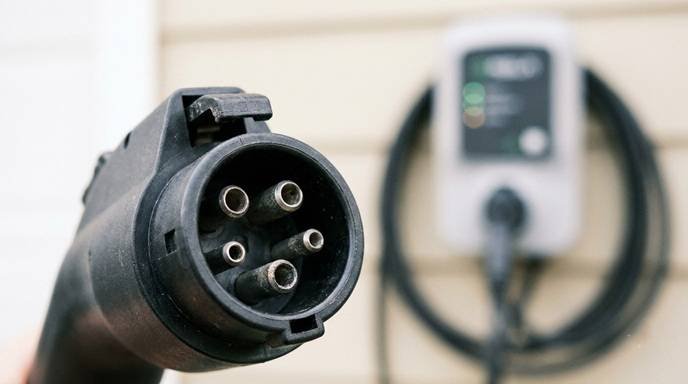
J1772 is the round five-pin AC connector used on a large share of North American plug-in vehicles for home charging. People call it Type 1. On many CCS1 cars, those same J1772 pins sit on the top of a combo inlet; the extra pins below are for DC only. Your garage wall unit uses the AC pins.
The box is EVSE (electric vehicle supply equipment). It is a protected, communicating 240-volt cord, not the device that fills the battery with DC. The onboard charger inside the car does the AC-to-DC conversion. That is why two neighbors can own the same wall unit and see different kilowatts on the dash.
A J1772 home charger can be a portable cord that plugs into a dedicated receptacle, or a wall unit that is hardwired. Same connector family. Different circuits, listings, and maximum current.
How Does a Level 2 J1772 Charger Work?
The path is panel → dedicated branch circuit → EVSE → J1772 handle → vehicle inlet → onboard charger → battery.
The EVSE does not slam 240 volts into the inlet when the latch clicks. It checks the connection, runs its protective functions, and sends a control signal that says, in effect, “you may draw up to this many amps.” The car answers by drawing no more than that, and no more than its onboard charger and battery thermal system allow.
If you offer 40 amps and the car’s AC limit is 32, you get 32. If the car could take 48 and the EVSE is set to 32, you get 32. Cold packs, a nearly full battery, or a charge limit you set at 80% can lower the draw further. The wall LED can look “slow” when the car is simply being careful.
That handshake is why a random 240-volt appliance cord is not an EVSE, and why a household extension cord is not a charging plan.
How Fast Does a J1772 Level 2 Charger Charge an EV?
Approximate power at 240 volts is current times voltage:
kW ≈ 240 × amps ÷ 1,000
| EVSE current | Approx. power at 240V | Rough idea of energy offered in 8 hours* |
|---|---|---|
| 16A | ~3.8 kW | ~30 kWh |
| 24A | ~5.8 kW | ~46 kWh |
| 32A | ~7.7 kW | ~62 kWh |
| 40A | ~9.6 kW | ~77 kWh |
| 48A | ~11.5 kW | ~92 kWh |
*Energy offered at the cord, before conversion losses, and only if the car actually draws that current the whole time. It will not, especially near 100%.

Range added per hour is power × the car’s miles per kWh. If a crossover averages about 3 miles/kWh, 7.7 kW is on the order of the mid-20s miles of range per hour. Highway winter driving at 2.5 miles/kWh makes the same 7.7 kW look closer to the high teens. The charger did not get slower. The car got thirstier.
Actual J1772 charging speed varies because onboard AC limits differ by model, year, and sometimes trim. Some plug-in hybrids accept only a modest AC rate. Some battery EVs take around 7–11 kW. Do not copy a neighbor’s 48-amp setting onto a car whose manual lists a lower AC maximum. Read the vehicle documentation for your VIN.
A 20–80% session is usually the useful home window: enough energy for the next day, less sitting at 100% if the maker prefers a daily cap. 0–100% always takes longer than kWh divided by kW because the pack tapers at the top.
J1772 Charger Amps, Breakers and Wattage Explained
Amps are the current the EVSE is set to offer. Voltage at Level 2 is 240V in a typical U.S. home. Watts (or kilowatts) are what you pay for and what fills the pack.
The circuit is not the same number as the charging current. EV charging is commonly treated as a continuous load — it can run for hours. Electrical requirements often size the branch circuit with extra capacity relative to that current so the breaker and wire are not asked to sit at 100% of rating all night. That is why a “40 amp J1772 charger” is not automatically a 40-amp breaker project. The EVSE listing and the electrician’s design set the wire and breaker.
J1772 charger amperage you shop for should be:
- No higher than you need for the miles you drive
- No higher than the car will accept
- No higher than a load calculation says the service can spare
The main breaker (100A, 150A, 200A) is the whole house. The EVSE breaker is one branch. Mixing those two numbers up is the most common 100-amp-panel confusion.
Electrical work must follow applicable local codes and the equipment instructions. A qualified electrician should verify circuit size, breaker type, GFCI/AFCI requirements as they apply, disconnects, and indoor/outdoor listing. Do not size a breaker from a blog table and land it yourself.
What Outlet Does a Level 2 J1772 Charger Need?
It needs the receptacle the EVSE is listed for, on a dedicated circuit installed for that duty — or no receptacle at all, if the unit is hardwired.
NEMA 14-50 is the 240-volt, four-prong receptacle many portable Level 2 cords use (also seen on ranges and RV pedestals). A J1772 NEMA 14-50 setup is still an EV circuit. It should not be a dryer outlet you share, a loose RV box in the garage, or an outlet that merely looks like 14-50.
NEMA 6-50 is a 240-volt three-prong configuration some welders and some EVSE cords use. Same rule: listing, dedicated circuit, correct wiring. Matching the blade shape is not a safety inspection.
Plug-in chargers live on those receptacles. Hardwired units land on the circuit without a plug. Higher listed outputs, including many 48-amp wall units, are often hardwired because that is how they are certified.
A household outlet should never be assumed suitable because the plug fits. Fit is not ampacity, GFCI, wire gauge, or continuous-load rating. If you already have a 14-50, have an electrician confirm it was installed for EV charging — terminations, wire size, breaker, and condition — before you park a 32- or 40-amp session on it for eight hours. Loose 14-50s under continuous load are a heat problem.
Can You Install a J1772 Charger on a 100-Amp Panel?
Direct answer: A J1772 charger 100 amp panel project can work at some charge rates in some houses and fail in others. The 100-amp label is the size of the service, not leftover room for a car.
Start with existing demand: HVAC, electric range, dryer, water heater, heat pump or electric furnace (especially backup heat strips), pool equipment, shop loads, another EVSE. Then add the EVSE as a continuous load at the amperage you actually want. An electrician’s load calculation — not spare breaker spaces — says whether that sum fits.
100A vs 150A vs 200A is headroom, not charging speed. A 200-amp all-electric house can still be busy. A 100-amp gas-heat house can have an easier overnight 32-amp session than a 200-amp house with two heat pumps and a hot tub.
Example 1 — 100A service, wanted 40A Level 2. Forty amps at 240V is about 9.6 kW for hours. On a quiet gas-heat home, a calculation might support it, with a circuit larger than 40A per continuous-load rules. On a house with electric dryer, range, and heat-pump strips, 40A may be the request that turns into 32A, listed load management, or a service-upgrade talk. Wanting 40A is not the same as having 40A of spare capacity.
Smart load management can throttle the EVSE when the house peaks so the oven and the car do not both demand their maximum at 6 p.m. That only helps if the equipment is listed for it and the baseline load is close to the line, not already over it.
A service or panel upgrade enters the picture when the calculation cannot support the rate you need, the panel is obsolete or full, or you already know a second EV or an all-electric remodel is coming. It is not a moral requirement of owning a J1772 car.
Which EVs Use J1772?
J1772 is an AC inlet standard, not a brand club. Through the mid-2020s, a long list of U.S.-market battery EVs and PHEVs used J1772 or the AC portion of a CCS1 combo inlet for home charging. Connector type and onboard AC kW change by model year. Several automakers have been adding NACS (SAE J3400) on newer vehicles. Confirm the inlet on the car in the driveway or on the window sticker — not the brochure from three years ago.
Vehicles frequently discussed in J1772 home-charging conversations include, among others:
- Hyundai Ioniq 5 and Ioniq 6
- Kia EV6 and EV9
- Ford Mustang Mach-E and F-150 Lightning
- Chevrolet Equinox EV and Blazer EV
- Nissan Ariya
- Volkswagen ID.4
- Rivian vehicles, depending on year
Treat every name on that list as year-specific. An Ioniq 5, Mach-E, Lightning, Equinox EV, or Rivian from one model year may present J1772/CCS1 for AC; a later one may present NACS. Trims do not all share the same onboard AC limit either. A dual-motor GT-style powertrain does not automatically mean a higher home-charge rate.
Plug-in hybrids from many brands still use J1772 for the small onboard charger. They often do not need 48-amp wall units. Matching a PHEV to a huge EVSE wastes panel capacity.
Tesla vehicles use NACS natively. They are the adapter case below, not J1772-native cars.
If you are shopping in 2026, look at the charge port before you look at wall-unit marketing. J1772 EV charger compatibility is a photo of the inlet plus the owner’s manual, not a manufacturer reputation.
Can a J1772 Charger Charge a Tesla or NACS Vehicle?
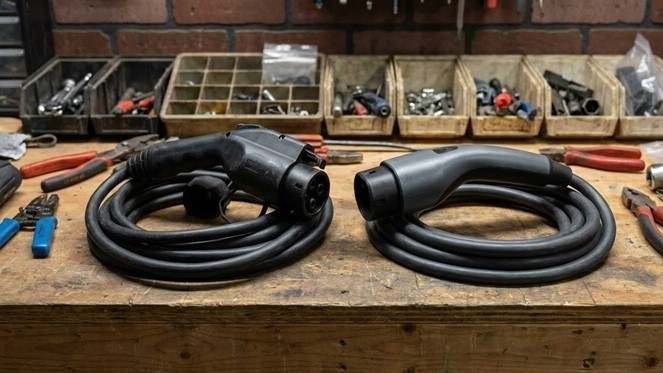
Connector compatibility: a J1772 handle does not mate with a NACS inlet. An adapter that is listed and rated for the current turns J1772 EVSE AC into something a NACS car will accept.
Charging capability: the adapter does not raise the Tesla’s (or any NACS vehicle’s) onboard AC limit. A 48-amp wall unit still becomes whatever the car will draw. It also does not enable DC fast charging. Superchargers and other DC networks are a different path.
Example 4 — NACS car, existing J1772 home charger. If the EVSE, adapter, and vehicle ratings all cover the amperage you use, Level 2 at home can keep working. If the adapter is unrated, undersized, or stacked with another dongle, stop. If the J1772 unit is 16 amps and the household now drives 80 miles a day, the bottleneck is the EVSE current, not the Tesla badge.
Use one adapter, seated fully, kept out of standing water, stored off the floor. Follow Tesla/NACS vehicle instructions and the EVSE manual. Portable convenience is AC only.
J1772 vs NACS
| J1772 (AC) | NACS / SAE J3400 | Level 1 (120V) | DC fast charge | |
|---|---|---|---|---|
| What it is | Legacy North American AC plug | Combined AC/DC inlet used by Tesla and expanding in 2026 | Household-outlet charging | High-power DC to the pack |
| Home role | Still the plug on millions of wall units and older EVs/PHEVs | Native on many newer EVs | Slow top-up | Rarely a home technology |
| Speed class | Level 2 when fed 240V | Level 2 on AC; DC at public stalls | ~1–2 kW | Tens to hundreds of kW |
| Adapter | J1772 EVSE → NACS car needs a rated AC adapter | NACS EVSE → J1772 car needs the other adapter, if allowed | Usually the mobile cord | Not a J1772 wall box |
J1772 vs NACS is not a contest with a single winner. NACS is showing up on more new vehicles and some public hardware. J1772 remains how a huge existing fleet charges in garages. Adapters bridge AC. DC remains a station-and-inlet problem, not a garage-J1772 problem.
Buy for the car you charge tonight. When you replace the car, look at the inlet again before you replace the wall unit.
J1772 vs Level 1 Charging
Level 1 is 120 volts, typically the mobile cord on a manufacturer-allowed household receptacle. Power is roughly 1–2 kW. A 30-mile day might recover overnight. A 70-mile day on a large pack will not.
Level 2 J1772 at 240V is several times that power. Choose Level 1 if miles are short, the plug-in window is long, and the panel is already strained. Choose Level 2 if the car is the daily driver, the pack is large, or you are tired of waking up to a battery that did not catch up.
Same J1772 handle can appear on some Level 1 cords. The connector does not make it Level 2. The 240 volts do.
J1772 Level 2 vs DC Fast Charging
DC fast charging bypasses the onboard charger and pushes DC into the pack at a station. Peak numbers look dramatic. They also taper, cost more per kWh at many sites, and are harder on a battery if you live on them.
Level 2 is the better overnight tool: lower power, cheaper residential energy in most U.S. tariffs, and a full (or 80%) car every morning if the math of miles versus kW works. Use DC for road trips and the occasional “I forgot.” Do not size a home J1772 unit as if it were a 150 kW stall. It will never be.
Plug-In vs Hardwired J1772 Charger
| Plug-in (often 14-50 or 6-50) | Hardwired | |
|---|---|---|
| Installation | Dedicated listed receptacle, then EVSE cord | EVSE landed on the circuit |
| Portability | Easier to take a portable unit | Stays on the wall |
| Maximum output | Capped by receptacle listing, circuit, and EVSE; many live in the 32–40A draw conversation | Can include 48A where the listing, car, and service allow |
| Outdoor use | Receptacle and EVSE both need the right wet-location listing | Enclosure rating still required |
| Convenience | Plug feels familiar; do not share the outlet | Daily grab-and-go |
| Flexibility | Useful if you might move, or want a portable backup | Better as the permanent household charger |
Example 2 — existing NEMA 14-50, J1772 EV. If that receptacle is dedicated, correctly wired, in good condition, and the EVSE is listed for it, a J1772 car can use it for Level 2 at the current the circuit and car allow. If it is the dryer outlet, an old RV plug, or gets hot in use, it is not ready. Hardwired versus 14-50 does not add amps to a 100-amp service. Same draw is the same load.
How Much Does a Level 2 J1772 Charger Cost?
Split the bill in two: equipment and installation. Hardware prices move with features (basic versus smart, indoor versus outdoor, cable length). Installation is where quotes scatter.
Distance from panel to stall, indoor versus buried conduit, garage versus driveway, panel spaces, whether the 14-50 already exists and is EV-ready, permits, and a possible service upgrade dominate labor. A six-foot indoor run with spare capacity is not a 200-amp meter-main replacement. Anyone quoting one nationwide number is ignoring your wall.
Local utility rebates, make-ready programs, and tax credits exist in some places and change. Confirm the current program with the utility or a primary government source before you subtract an incentive from the quote.

How Much Electricity Does a J1772 Charger Use?
You pay for kilowatt-hours (kWh) at the meter. Energy stored in the battery is a bit less because the onboard charger is not 100% efficient. Wall kWh will exceed pack kWh. That gap is normal, not a broken EVSE.
Rough supply math if the car actually holds the current:
- 32A × 240V ≈ 7.7 kW → about 7.7 kWh per hour
- 40A ≈ 9.6 kWh per hour
- 48A ≈ 11.5 kWh per hour
A 40-mile day at 3 miles/kWh is about 13 kWh into the pack, plus losses at the wall. At 32A that is a couple of hours, not an all-night marathon. The marathon happens when you start low, drive a lot, or trickle on Level 1.
Time-of-use rates make when you charge as important as how many kWh. A smart schedule can matter more than an extra 8 amps.
How to Choose the Right Level 2 J1772 Charger
Work the chain in this order:
Vehicle → maximum AC charging rate → electrical service → circuit → outlet or hardwire → charger features → installation.
Checklist:
- Vehicle charging capability. Manual or in-car setting for max AC kW/amps.
- Amperage. 24/32/40/48 only as the car and service allow. A 40 amp J1772 charger is not “better” than 32A on a car that stops at 32A.
- Electrical service. Load calculation on 100/150/200A, including future second EV.
- Connector. J1772 native, or NACS plus a rated adapter.
- NEMA vs hardwired. Match the listing; do not force 48A onto a receptacle the product is not listed for.
- Cable length. Path around the bumper to the inlet, usually front-left on many crossovers.
- Indoor/outdoor and weather rating. Driveway units need a wet-location listing.
- Safety certification. U.S. NRTL listing (for example UL or equivalent).
- Smart charging and load management. Useful for TOU rates, two cars, or a tight panel — if the unit still charges when Wi-Fi dies.
- Warranty and support. Wall boxes fail; firmware should not be the only off switch.
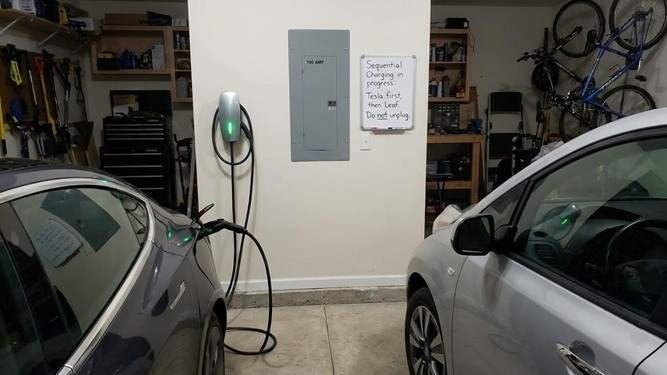
Example 3 — two EVs on one house. Two maximum-rate Level 2 sessions plus dinner is the hard case on 100-amp service. Sequential plugging, a listed load-sharing pair, Level 2 for the long-commute car and Level 1 for the short one, or a later service upgrade are the real options. Two wall units at 48A with no plan is how the project becomes a panel replacement.
Internal reading that pairs with this decision (when you publish them): J1772 charger on a 100 amp panel; 40 amp vs 48 amp EV charger; J1772 vs NACS; EV charger load management; Level 2 charger installation; Ioniq 5 or EV9 home charging by model year.
Common J1772 Charging Problems
Won’t start. Charge schedule in the car, connector not latched, inlet door, EVSE waiting on a fault, or a vehicle “hold until departure” setting.
Stops unexpectedly. Hit the SOC cap, GFCI trip, over-temp, loose 14-50, or a smart charger losing its mind after a Wi-Fi drop (a good unit should still charge).
Slow charging. EVSE current set low, onboard limit, cold battery, sharing a circuit, or comparing Level 2 to a DC stall.
GFCI trips. Moisture, damaged cord, or a real ground fault. Repeated resets are not a repair.
Hot plug or outlet. Stop. Have a qualified electrician inspect the receptacle and terminations. Heat under continuous load is how 14-50s fail.
Communication errors. Pilot-signal / EVSE fault, damaged handle, bad adapter. Try another listed Level 2 if you can do so safely; if the car charges elsewhere, look at home gear.
Adapter problems. Unrated adapters, stacked dongles, pins not fully seated, water in the joint.
Vehicle limits. Some years throttle AC in heat or cold; some PHEVs never draw 40A. Read the dash kW before blaming the wall.
Safe first steps: vehicle settings, reseat the handle, read EVSE lights, stop if anything is hot or smells like melting. Do not open an energized panel. Breaker trips and heat get a professional.
J1772 Level 2 Charger Safety Tips
- Use listed EVSE and listed adapters only, at or above the current you run.
- Dedicated circuit; no dryer splitters, no household extension cords.
- Keep the connector off wet concrete; hang unused cable.
- Indoor-only gear stays indoors.
- If a 14-50 is warm, buzzing, or discolored, stop charging there.
- Kids and pets: holster the handle.
- Permits and inspection exist so the next owner and the insurer see a real circuit.
- Hire a qualified electrician for new circuits, hardwired units, panel work, and service upgrades.
Frequently Asked Questions
Is J1772 a Level 2 charger?
J1772 is a connector. Level 2 is 240-volt AC charging. Most home J1772 wall units are Level 2. Some portable J1772 cords are Level 1 on 120V.
How fast is a J1772 Level 2 charger?
At 240V, 32A is about 7.7 kW and 40A about 9.6 kW if the car draws it. That is overnight-commute speed for many drivers, not DC fast charging.
Can I use J1772 at home?
Yes, if the car has a J1772 or CCS1 AC inlet (or a NACS inlet plus a rated adapter) and you install listed EVSE on a proper circuit.
Does J1772 work with Tesla?
For AC, with a compatible J1772-to-NACS adapter. Not for Tesla DC fast charging.
What outlet does J1772 use?
Whatever the EVSE is listed for — often NEMA 14-50 or 6-50 — or no outlet if hardwired. A matching plug shape is not enough.
Can J1772 work on a 100-amp panel?
Sometimes, at a rate a load calculation supports. 100A is the whole house. Electric heat and large appliances make 40A and 48A harder.
Is NEMA 14-50 required?
No. It is one plug-in method. Hardwired EVSE is the other common path, especially at higher listed currents.
Is hardwired better than plug-in?
Hardwired is often cleaner for a permanent daily charger and for 48A-listed units. Plug-in is more portable. Same amps are the same load on the service.
Is J1772 being replaced by NACS?
NACS is spreading on new vehicles in 2026. J1772 remains on millions of cars and wall units. Adapters cover AC. Check the inlet on the next car.
What is the best amperage for a J1772 charger?
The best amperage is the one the onboard charger will use and the service can spare. For many homes that is 32A. 48A is extra speed only if both car and panel agree.
Can two EVs share one J1772 circuit?
Not by plugging two cars into one EVSE at once. Use sequence, two managed EVSE units, or mixed Level 1/Level 2. Plan this before the second delivery.
Do I need a 48 amp J1772 charger?
Only if the car accepts that AC rate and the electrical service can support ~11.5 kW continuous. Otherwise you paid for unused headroom.
A level 2 j1772 charger is still one of the most practical ways to charge at home in the United States: 240 volts, a connector millions of cars already know, and overnight speed that Level 1 cannot match. It is not a magic number of amps, and it is not automatically compatible with every new NACS inlet without an adapter.
Choose the equipment from four facts, in order: the car’s maximum AC rate, the house’s available capacity (a load calculation, not the main-breaker label), the speed you actually need for your miles and parking hours, and a listed installation — hardwired or a proper 14-50 — done by a qualified electrician to local requirements. Add cable length, indoor/outdoor rating, and smart features only after those four agree. If you remember one line: the wall box offers current, the car accepts current, and the panel has to be able to spare it. Match those three, and J1772 Level 2 becomes boring in the best way — plug in, go inside, leave in the morning.
Related Post