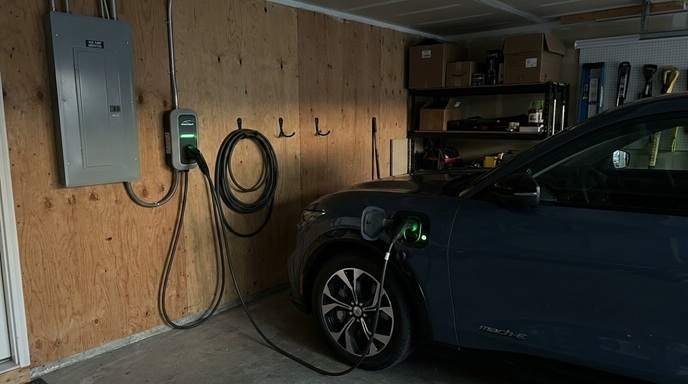
You bought the Mach-E — or you are about to — and then you look at the electrical panel. The main breaker says 100 amps. Online forums mention 40-amp chargers, 48-amp chargers, and neighbors who “had to go to 200 amps.” The question lands hard: do you need an expensive service upgrade before you can charge at home?
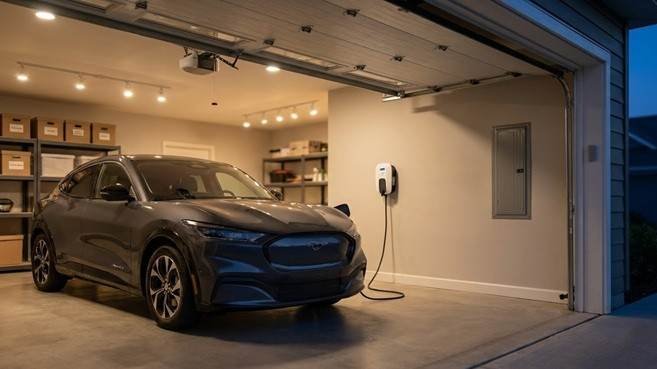
The question matters because a Level 2 charger is not a phone charger. It can be one of the largest continuous electrical loads in the house, running for hours while you sleep. Charger amperage alone does not answer it. A 40-amp EVSE on a lightly loaded all-gas house is a different problem than the same EVSE in a home with electric heat, an electric dryer, a range, and a heat pump fighting a cold Monday morning.
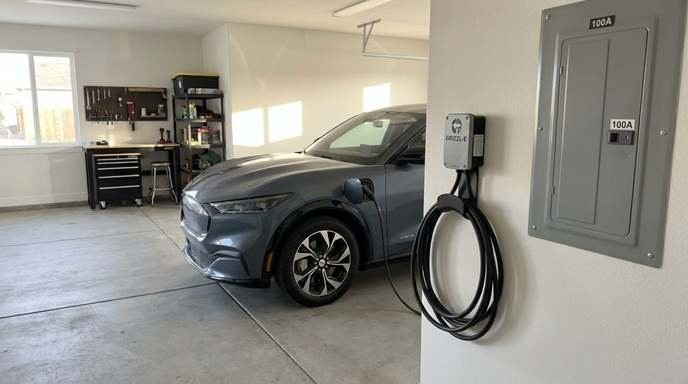
A Mustang mach e home charger on a 100 amp panel can work in some houses and be a poor fit in others. Suitability depends on existing household demand, the charger and circuit configuration, applicable electrical requirements, and a site-specific installation — not the car’s badge and not the number printed on the main breaker by itself.
A concise answer: overnight home charging is often possible on 100-amp service, especially at Level 1 or a moderate Level 2 rate, if an electrician confirms enough spare capacity. The service rating is the starting point, not the verdict.
Can You Charge a Mustang Mach-E With a 100 Amp Panel?
Yes, a Mach-E can sometimes charge at home on 100-amp residential service. Whether your house can do it depends on leftover capacity after existing loads, the charging rate you choose, and a proper electrical evaluation — not on the 100-amp label alone.
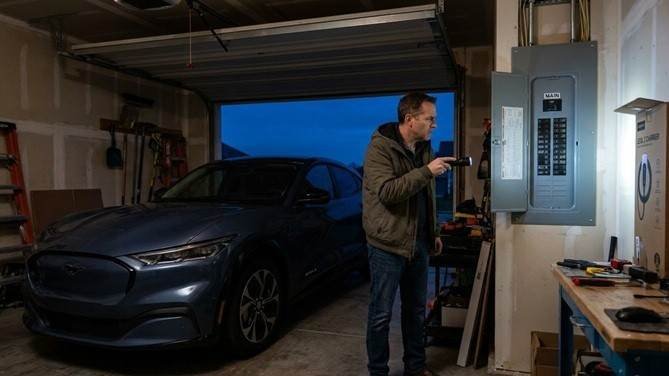
First, separate two things people mix up constantly.
A 100-amp electrical service is the main feed into the home: the utility supply, the meter, and the main breaker that protect the whole house. A 100-amp circuit or breaker is a branch circuit feeding one load or a subpanel. Installing a Mach-E charger does not mean you tap a 100-amp branch breaker. It means you add a new charging load onto a house whose total service is 100 amps.
That total is the constraint. Lights, HVAC, kitchen appliances, laundry, water heating, and the EVSE all share the same service. If those loads can overlap in a realistic way, the panel does not get a free extra 40 or 48 amps just because the Mach-E is parked in the garage.
The car and the charger are also not the same device. The Mustang Mach-E can only accept as much AC power as its onboard charger allows, and that capability can vary by model year, battery, and equipment. The EVSE (the wall unit or portable cord) can only deliver what it is designed and installed to deliver. The circuit can only supply what it is rated and installed to supply. The service can only support what remains after the rest of the house is accounted for. Mustang Mach-E home charging requirements are the overlap of all four.
can Mach-E charge on a 100 amp panel? Sometimes. A Mach-E charger on 100 amp service is a load-planning problem. A qualified electrician should evaluate the existing service, perform or review an appropriate load calculation, and size the installation to the house you have — including permits and local electrical requirements — before anyone picks a 48-amp wall unit off a product page.
How Much Power Does the Mustang Mach-E Home Charger Need?
Home charging comes in two broad speeds.
Level 1 uses 120 volts, typically from a household receptacle the manufacturer allows. Power is modest, often in the neighborhood of about 1 to 2 kW depending on the circuit and the EVSE. It is slow. For a driver who adds a short commute and can leave the car plugged in for many hours, it can still replace gasoline-trip thinking.
Level 2 uses 240 volts. Power is amperage times voltage. At 240V, 32 amps is about 7.7 kW, 40 amps is about 9.6 kW, and 48 amps is about 11.5 kW. Those are electrical-supply numbers, not a promise the Mach-E will always pull that much.
Amperage is the current. Power (kilowatts) is what actually refills the battery. Homeowners shop “40-amp chargers” because the number is on the box. The useful question is how many kilowatts the car will draw for how many hours, and whether the house can spare that continuous load.
A higher-rated charger does not force the vehicle to its maximum. The Mach-E’s onboard charging system is the bottleneck on AC. If the car’s onboard limit is below what the EVSE can output, the extra charger rating is unused headroom, not faster charging. If the EVSE is set or installed below what the car could accept, the charger is the bottleneck. Model year, trim, and charging equipment can change those limits, so use the owner’s manual and the EVSE instructions for the vehicle you actually own.
Think of it as three stacked governors: the car will not take more AC than the onboard charger allows; the EVSE will not supply more than it is configured to supply; the house should not be asked for more than the service and the installation can support.
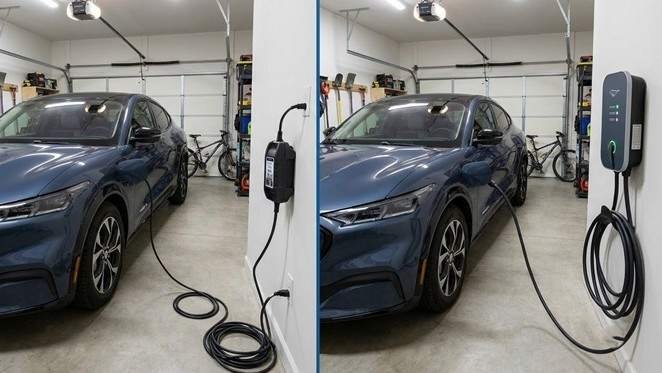
What Happens When You Install a Level 2 Charger on a 100 Amp Service?
Level 2 charging is a large, long-running load. A dryer also draws a lot, but it cycles. An EVSE can sit near its set current for an entire overnight session. That is why EV charging is commonly treated as a significant, often continuous, load in residential electrical design. Continuous loads are typically accounted for more conservatively than a toaster you use for two minutes. Exact circuit sizing must follow the EVSE listing, manufacturer instructions, and applicable electrical requirements — often including extra capacity on the branch circuit relative to the charging current. That is a job for the installer, not a forum rule of thumb.
Common Level 2 charging currents and approximate power at 240V:
| Charging current | Approx. power at 240V | What it feels like on a 100A service |
|---|---|---|
| 32A | ~7.7 kW | Substantial, but among the more modest full Level 2 rates |
| 40A | ~9.6 kW | A major appliance-class continuous load |
| 48A | ~11.5 kW | One of the larger 240V loads many homes will ever add |
A 100-amp, 240-volt service has a theoretical 24 kW of capacity. You do not get to spend 24 kW on a car. Lighting, HVAC, kitchen, laundry, and heating already claim a share, and load calculations use demand factors rather than adding every nameplate until the panel cries. Still, a 9–12 kW EVSE is not a rounding error on a 100-amp house. It can be workable when other large loads are gas-fired, modest, or unlikely to peak at the same time. It can be too much when the house is already electrically busy.
Mustang Mach-E 32 Amp vs. 40 Amp vs. 48 Amp Charging
No amperage is automatically safe or unsafe on every 100-amp home. The table is about relative demand and typical use, not a permit.
| Charging current | Approx. power at 240V | Relative electrical demand | Approximate use case | Suitability considerations on 100A service |
|---|---|---|---|---|
| 32A | ~7.7 kW | Lower among common Level 2 rates | Overnight catch-up for many commuters | Often the easiest Level 2 fit if spare capacity exists |
| 40A | ~9.6 kW | Moderate to high | Faster overnight; less waiting after a long day | Needs more unused capacity; circuit is larger than the charging current |
| 48A | ~11.5 kW | High for a 100A house | Shorter sessions, larger daily miles, future-proofing | Largest of these three; only makes sense if the load calculation supports it |
32A. Advantages: less strain on a tight service, still many times faster than Level 1, often enough to replace a day’s driving overnight. Disadvantages: slower than a 40A or 48A session if you regularly arrive home very low and leave early.
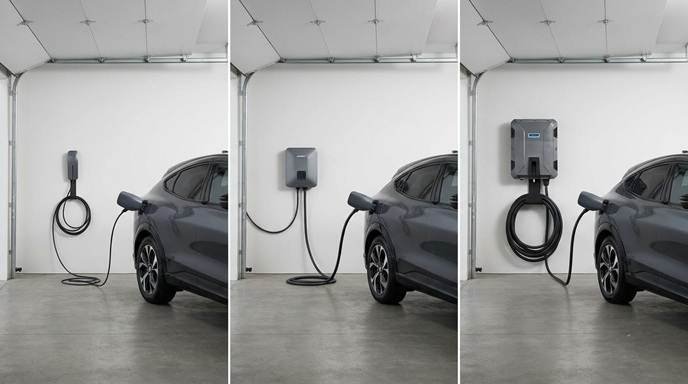
40A. Advantages: a noticeable step up in kW; popular “default” shopping number. Disadvantages: people treat “40 amp” as a small add-on. On a 100-amp service it is not small. The Mach-E 40 amp home charger only works if the house has room for that continuous draw.
48A. Advantages: closest to what many modern onboard chargers can use, shorter plug-in time for the same energy. Disadvantages: highest demand of the three, typically the largest associated circuit, and the option most likely to collide with electric heat, cooking, and laundry on a 100A panel.
If overnight is your real window and you drive a moderate commute, stepping down a charging rate can be the difference between “fits the service” and “upgrade the service.” If you regularly need a lot of energy in a short window, the electrical conversation gets more serious — and it may not be a charger-shopping conversation anymore.
Can a 40 Amp EV Charger Work on a 100 Amp Panel?
A 40-amp charger can work on 100-amp service in some homes, but only if a load evaluation shows enough spare capacity and the circuit is installed to applicable requirements. “40-amp charger” is not a small accessory, and it is not the same thing as a 40-amp breaker.
What people call a 40 amp EV charger on 100 amp panel usually means the EVSE is set or rated so the vehicle draws about 40 amps at 240 volts — roughly 9.6 kW. The circuit that feeds that EVSE is related but not identical. Because charging is commonly treated as a continuous load, the branch circuit is often sized larger than 40 amps so the wiring and breaker are not asked to run at 100% of rating for hours. The exact size comes from the equipment listing and electrical requirements, not from matching the marketing number on the charger.
The home’s existing loads still have to make room. A 40-amp charging session on a 40 amp charger 100 amp service setup is asking the house to spare a large slice of its main service for hours. In a home with gas heat and a quiet electrical evening, that can be realistic. In a home where a heat pump, water heater, and dryer may already be on, it may not.
An electrician should determine whether a 40-amp charging rate is appropriate, what circuit and wiring the listed EVSE requires, whether the panel can accept the new breaker, and whether load management or a lower charge rate is the better Mach-E 40 amp home charger plan. That is not a DIY matching game between two numbers that both say “40.”
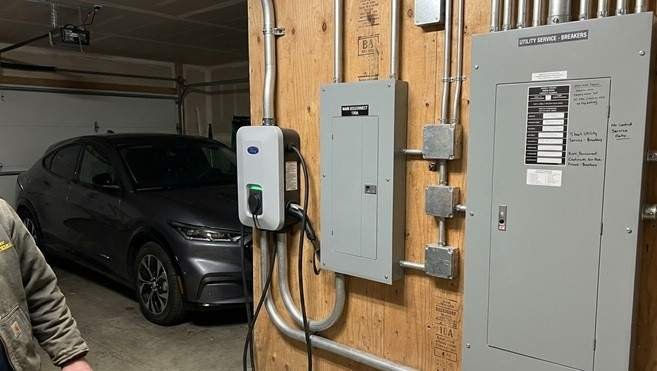
Can a 48 Amp Charger Work on a 100 Amp Panel?
A 48-amp charger is a heavier continuous load than 32A or 40A. A 100-amp service does not automatically allow it or forbid it. The calculated load of that house decides.
At 240V, 48 amps is about 11.5 kW. On a 100-amp service, that is a large share of the theoretical pie. Some electrically light homes still have room. Many electrically heavy homes do not, especially with electric heating or several 240-volt appliances.
Hardwired versus plug-in does not magically create capacity. A hardwired 48A EVSE and a plug-in unit that actually delivers a similar current both add similar demand if they run at that current. What changes is installation method, receptacle listing, indoor/outdoor rating, and what the manufacturer and code allow for that product. Those are installer details. They do not give the main service extra amps.
If you want a Mach-E 48 amp charger because the box number is bigger, pause. Confirm the car will use that current, confirm the EVSE can be set lower if needed, and let a professional load calculation say whether 48A belongs on this panel at all. Choosing 48A on a 100A house “for future-proofing” can be the opposite of future-proofing if it forces an upgrade you could have delayed with 32A and honest driving math.
How to Determine Whether Your 100 Amp Panel Has Enough Capacity
The chain is simple to say and easy to get wrong in practice:
100A service → existing household demand → EV charging load → available capacity
You start with the service size. You subtract, in the electrically proper way, what the house already needs. You add the EVSE as the installer must add it (including how continuous loads are counted). What remains is whether the charging rate you want is plausible.
Homeowners cannot reliably do this by adding nameplate stickers from the dryer and the oven. Official residential load calculations use demand factors, occupancy assumptions, and rules that exist because not every appliance runs at full blast at once. A simplified walk-through is only for intuition.
Common major loads that eat 100-amp headroom:
- Central HVAC or window/mini-split clusters
- Electric water heater
- Electric range / wall oven / cooktop
- Electric clothes dryer
- Electric furnace
- Heat pump (and emergency heat strips)
- Pool pump, heater, or hot tub
- Large garage tools, welders, air compressors
- Another EV charger
Simplified hypothetical (not a load calculation, not approval to install): Imagine two 100-amp houses.
House A uses gas for heat, water, and cooking. The big remaining 240-volt loads are a dryer and air conditioning that rarely peak at midnight. Evening demand might leave meaningful room for a moderate Level 2 session.
House B is all-electric: heat pump with backup strips, electric water heater, electric range, electric dryer. A winter morning can already stack heating and hot water. Adding a 40A or 48A EVSE on top of that stack is how 100-amp services run out of room even if the panel “looks empty” because there are a few spare breaker spaces.
Spare breaker spaces are not spare capacity. An empty slot means there is room to land a breaker, not that the utility service can feed another 11 kW all night.
Have an electrician calculate the load, inspect the panel condition, check grounding and available spaces, and compare that result with the EVSE you want. The hypothetical is a flashlight. The calculation is the map.
What Appliances Make a 100 Amp Panel Challenging for a Mach-E Charger?
Simultaneous demand is the trap. The Mach-E does not care that the dryer “usually runs at 8 p.m.” The service only cares what is on at once.
Mach-E + Electric Dryer
Can I charge a Mustang Mach-E with a 100 amp panel and electric dryer? Sometimes, if they do not need to peak together at a high EVSE rate. Dryers are large 240-volt loads. Overnight charging plus a late-night extra load of towels can stack. Scheduling laundry earlier, or charging at 32A instead of 48A, is often more effective than hoping the two loads never overlap.
Mach-E + Electric Range
Ranges spike when several burners and an oven run. Dinner plus plug-in at 5:30 p.m. is a classic overlap. If you charge after cooking winds down, the coincidence shrinks. If you need the car to start charging the minute you get home, the range and the EVSE are competing during the household peak.
Mach-E + Electric Water Heater
Water heaters recover after showers. Evening showers plus Level 2 charging is a real stack, especially on tanks that reheat at high power. Heat-pump water heaters usually draw less than traditional electric resistance units, but they still count. The issue is coincidence, not the Mach-E being “incompatible” with hot water.
Mach-E + Heat Pump
Heat pumps run a long time in cold weather. Backup resistance heat, if equipped, can be a huge add-on load — the kind of load that makes a 100-amp service feel small even before an EV. Winter overnight charging is exactly when the house may already be electrically hungry. This pairing is one of the strongest reasons to get a real load calculation instead of copying a California garage setup from a forum.
Mach-E + Electric Furnace
Electric furnaces are among the least forgiving partners for a large EVSE on 100-amp service. They can occupy a major fraction of the service when they run. A Mach-E charger on 100 amp service in an electric-furnace house is frequently a “lower the charge rate, add load management, or discuss a service upgrade” conversation.
Mach-E + Pool Equipment
Pool pumps may run on timers that overlap evening charging. Pool heaters are worse. If the equipment is seasonal, winter charging may be easy and July charging may not. Timer schedules are part of EV planning in those homes.
Mach-E + Second EV
Two vehicles can double the energy you need overnight even if they do not double the instantaneous amps, depending on how you charge. Two maximum-rate Level 2 sessions at once is the hard case. Alternating cars, load sharing, or a single charger used in sequence is the practical case. More on that below.
Do You Need to Upgrade From 100 Amp to 200 Amp Service for a Mach-E?
Not automatically. Some 100-amp homes can add Mach-E charging without a service upgrade. Others cannot, especially with electric heat and several large appliances. A load calculation, not a rule of thumb, should drive that decision.
A service upgrade becomes relevant when the calculated load, including the EVSE at the rate you actually need, exceeds what the existing service can support — or when the panel is obsolete, full, damaged, or otherwise unfit. It also becomes relevant when you already know the next five years include a second EV, electric cooking, or a heat-pump conversion.
Some homes install EV charging without a service upgrade by using Level 1, a modest Level 2 rate, off-peak scheduling, or listed load-management equipment. Other homes have so little spare capacity that even 32A Level 2 is a stretch.
Cost implications are local. A charger plus a short indoor circuit is a different project from replacing service conductors, the meter socket, the panel, and grounding, plus utility coordination and permits. Upgrades are often among the larger line items in a home-charging project when they are required. They are also how you buy headroom for more than this one car.
Do not treat 200-amp service as a Mach-E requirement. Treat it as one tool when 100 amps is genuinely full — or when you want the house ready for a more electric future.
Can Load Management Avoid a 200 Amp Panel Upgrade?
Sometimes. EV charger load management means the charging current is reduced, paused, or shared so the house does not exceed a set limit. Dynamic load management watches whole-home current (or a feeder) and throttles the EVSE when HVAC, cooking, or laundry spikes. Smart EV charging may use schedules, utility rates, app limits, or vehicle settings to keep the session in a quieter electrical window. Load sharing splits a defined budget between two EVSE units so they cannot both run at maximum at once.
For a smart EV charger 100 amp service situation, the appeal is obvious: you keep a useful Level 2 circuit, but the car does not insist on 40A while the oven and dryer are on. EV load management without panel upgrade is exactly this idea.
It is not a loophole. The equipment must be listed for the purpose, compatible with the EVSE, and installed to manufacturer instructions and local requirements. Some utilities also have interconnection or rebate rules for controllable chargers. Mach-E charger load management can include a lower locked-in amperage in the EVSE, a vehicle charge-current setting if the car provides one, a scheduled start after the household peak, or a whole-home current sensor. Which of those is acceptable for your panel is an installer-and-code question, not a software trick to ignore capacity.
Load management is most useful when the house is close to the line — not when the service is already maxed by electric heat alone. If the calculated load is far over capacity even with the EVSE at a modest rate, management may not replace an upgrade.
Best Mustang Mach-E Charging Setup for a 100 Amp Service
There is no single best charger. There is a best match among driving habits, overnight window, and spare capacity.
Option 1: Level 1 Charging
Suits drivers with a short daily round trip, a long plug-in window, and a tight panel. Power is low, so it is the gentlest add to a 100-amp service. Poor fit if you regularly drive long distances and need a lot of energy by 7 a.m.
Option 2: 32A Level 2 Charging
Suits many commuters on 100-amp services that have some room but not a blank check. Overnight, 32A often replaces a typical day’s miles with margin, depending on efficiency, weather, and starting charge. It is frequently the most realistic “real Level 2” starting point on a busy 100A panel.
Option 3: 40A Level 2 Charging
Suits homes with demonstrated spare capacity and drivers who want faster recovery after longer days. It is not the default just because 40-amp units are common for sale. If the load calculation is tight, 40A is how a workable project becomes an upgrade project.
Option 4: 48A Level 2 Charging
Suits electrically lighter 100-amp homes, or drivers who truly need shorter sessions — and only if the service, circuit, EVSE listing, and onboard charger all line up. On many 100A houses it is the last option to consider, not the first.
Option 5: Load-Managed Charging
Suits households that want Level 2 convenience but have spiky evening loads: cooking, laundry, heat pumps. The car still charges; it just yields when the house peaks. Worth investigating before you write a check for 200-amp service, provided the numbers are close rather than hopeless.
Match the setup to miles, not to maximum brochure amps. A Mach-E that returns home at 50% after 35 miles does not need the same installation as one that returns at 15% after 120 miles.
NEMA 14-50 vs. Hardwired Charger for a Mustang Mach-E
A Mustang Mach-E NEMA 14-50 charger setup uses a 240-volt receptacle (the range/RV-style four-prong outlet many people recognize). A Mach-E hardwired charger lands the EVSE on a dedicated circuit without that receptacle.
| Topic | NEMA 14-50 (plug-in EVSE) | Hardwired EVSE |
|---|---|---|
| Installation approach | Dedicated receptacle on a dedicated circuit, then a listed portable or plug-in EVSE | EVSE connected permanently to the circuit |
| Charging capability | Limited by the receptacle, circuit, EVSE rating, and vehicle; often associated with moderate Level 2 rates, not automatically 48A | Can support whatever the listed unit, circuit, and vehicle allow, including higher rates where permitted |
| Portability | Easier to unplug a portable unit (still not an excuse for random extension cords) | Stays on the wall |
| Outdoor considerations | Receptacle and EVSE must be listed for the location; weather covers and wet-location rules matter | Enclosure rating and listing still matter; no outdoor “temporary” receptacle habits |
| Circuit requirements | Dedicated circuit sized and installed per the EVSE, receptacle listing, and electrical requirements | Dedicated circuit per the hardwired EVSE listing and electrical requirements |
| Convenience | Familiar plug; tempting to share with other tools — do not | Cleaner daily use; one job, one circuit |
| Long-term | Fine for many homes; receptacle condition and tight connections matter under continuous load | Often preferred for a permanent daily charger |
A Mach-E 14-50 vs hardwired charger choice does not decide whether the 100-amp service is adequate. Both add a large 240-volt load if they charge at Level 2 currents. Plug-in is not “gentler” electrically at the same amperage.
When 14-50 may make sense: you want a listed plug-in/portable EVSE, a moderate charge rate the receptacle and circuit actually support, or flexibility to take a portable unit elsewhere — still using only the cords and inlets the manufacturer allows.
When hardwired may make sense: a permanent wall unit, a higher listed charge rate, a cleaner garage install, or an EVSE that is not intended to be cord-and-plug connected.
Do not install either as a DIY panel project. Receptacles used for EV charging see long, high current. Loose 14-50s are a known heat problem when they are treated like an occasional RV outlet. Installation quality matters as much as the amperage printed on the charger.
Can You Use the Ford Mobile Charger on a 100 Amp Panel?
The Ford mobile / portable charging cord that comes with many Mach-E orders is meant for convenient charging, especially Level 1 on a standard household receptacle the manufacturer specifies. It is not a substitute for a load calculation just because it “only plugs into the wall.”
On 120 volts, the draw is much smaller than Level 2. That is why a Mustang Mach-E 100 amp panel household can often use Level 1 with less drama — if the receptacle’s circuit is appropriate, not already overloaded with other loads, and used exactly as Ford instructs. A garage opener circuit shared with a freezer is not automatically a good charging circuit.
Some mobile charging kits can operate at higher voltage when connected to a manufacturer-specified 240-volt receptacle. If yours can, that configuration is electrically closer to a plug-in Level 2 EVSE: more speed, more demand on the 100-amp service. Follow the current Ford instructions for your cord, adapters, and vehicle. Do not assume every adapter in a drawer is approved.
The home’s available capacity still matters at Level 1, just less often as the deciding factor. At 240V through a mobile cord, it matters a lot. Unsuitable extension cords and random adapters are a common, unsafe shortcut. If the mobile charger will not reach, the answer is a proper receptacle or wall EVSE — not a longer household extension cord.

How Fast Will a Mustang Mach-E Charge at Home on a 100 Amp Service?
The service size does not set charging speed. The EVSE output, the car’s onboard limit, battery state, temperature, and settings do. A 100-amp house that only has room for 32A charges at 32A, not at “100-amp speed.”
Approximate supply power at 240V (if the car actually draws that current):
| Setup | Approx. power | What it means in practice |
|---|---|---|
| Level 1 (~120V) | ~1–2 kW | Slow; hours per meaningful chunk of range |
| 32A Level 2 | ~7.7 kW | Typical “solid overnight” Level 2 |
| 40A Level 2 | ~9.6 kW | Faster recovery |
| 48A Level 2 | ~11.5 kW | Among the quicker AC home rates, if the car will take it |
Miles of range per hour is not a factory constant. Mach-E efficiency changes with RWD vs. AWD, wheel size, weather, speed, and cabin heat. As a rough illustration only, if the car averages around 3 miles per kWh in mixed conditions, then about 7.7 kW is on the order of the mid-20s miles of range per hour, 9.6 kW a bit under 30, and 11.5 kW the mid-30s — and a cold week or a GT-style setup can look worse. Do not treat those as guaranteed.
Real-world charging also tapers as the battery fills, may slow in extreme temperatures, and will never exceed the onboard AC limit even if the wall unit is larger. Use the truck’s displayed kW and your own commute math, not a viral miles-per-hour chart.
Can You Charge a Mustang Mach-E Overnight on a 100 Amp Panel?
Often yes, if the overnight window covers the kWh you actually used and the charging rate you are allowed to run. A 30-mile day and a 100-mile day are different electrical jobs.
Energy needed is miles divided by efficiency. At about 3 miles/kWh, 30 miles is about 10 kWh; 60 miles is about 20 kWh; 100 miles is about 33 kWh. Your car will differ.
Hypothetical 1 — 30 miles/day, 8-hour night, Level 1. About 10 kWh. Level 1 at ~1.4 kW needs on the order of 7 hours if it actually holds that rate. Tight but possible if you plug in every night and do not start empty. Easy on a 100-amp service compared with Level 2.
Hypothetical 2 — 40 miles/day, 8 hours, 32A Level 2. About 13 kWh. At ~7.7 kW you need roughly two hours of actual charging, not eight. The 100-amp question is whether those two hours (or a longer trickle) overlap other loads, not whether the clock runs out.
Hypothetical 3 — 100 miles/day, home at 20%, leave at 6 a.m. You may need most of a sizable battery slice in one night. Level 1 will not keep up. 32A might, if you have enough hours and the car will charge the whole window. 40A or 48A shortens the session but only if the panel can spare them. This driver on a 100-amp all-electric house is the person who should not guess.
Starting state of charge matters as much as miles. A Mach-E that lives between 40% and 70% is an easier overnight project than one that arrives at 8% twice a week.
Can a Mustang Mach-E Share a 100 Amp Panel With Other Appliances?
Yes — that is what a service is. Sharing is not the same as running every large load at once.
HVAC, dryer, oven, water heater, heat pump, pool equipment, and another EV all reduce the leftover budget for charging. The dangerous assumption is that charging happens in a vacuum at 11 p.m. In real houses, someone starts a dryer, emergency heat kicks on, or a water heater recovers.
Scheduling helps when you can actually shift loads: charge after 9 p.m., dry clothes on weekends, preheat the cabin while still plugged in instead of using a huge climate load after unplugging. Load management helps when you cannot trust the schedule. Lowering the EVSE current helps when the math is tight every single night.
Sharing a panel works until coincidence makes it not work. The installation should be designed for realistic coincidence, not for a perfect household that never cooks while the car charges.
Can Two EVs Charge on a 100 Amp Panel?
Two EVs do not automatically require two chargers at maximum output. They require enough energy by morning and a plan for power so the service is not asked for two 40A sessions plus dinner.
Mach-E + another EV on 100-amp service is commonly handled by:
- One Level 2 EVSE used in sequence (plug the second car in when the first is done)
- Two EVSE units with load sharing so their combined current stays under a set cap
- Smart charging that staggers start times
- Level 2 for the long-commute car and Level 1 for the short-commute car
Two full-rate Level 2 chargers with no management is the expensive interpretation of two EV chargers on 100 amp panel. It is also the interpretation most likely to collide with a service upgrade.
A second car is future electrical demand. If you are installing now and a second EV is likely, say so to the electrician. It is cheaper to plan a shareable circuit or a managed pair than to discover the “perfect” 48A install leaves no room for the next vehicle.
100 Amp vs. 150 Amp vs. 200 Amp Service for Mustang Mach-E
Higher service rating means more potential headroom. It does not guarantee faster charging. A 200-amp house can still have a 32A EVSE. A 100-amp house can still have a well-behaved overnight session.
| Service | Household flexibility | EV charging considerations | Multiple-EV considerations | When evaluation is especially important |
|---|---|---|---|---|
| 100A | Least spare room, especially all-electric | Modest Level 2 or Level 1 often in play; 48A is a high bar | Sharing and sequencing matter | Electric heat, dryer + range + water heater, second EV |
| 150A | More middle ground where it exists | Easier to fit moderate Level 2; still not unlimited | Better odds for managed dual charging | Older panels, mixed gas/electric, renovations |
| 200A | Most common “room to grow” target in many U.S. homes | Easier to support higher AC rates if the rest of the house allows | More realistic simultaneous or near-simultaneous charging | Not a substitute for a load calc if the house is all-electric and busy |
Professional evaluation matters at every size. It matters most when the service is 100A and the wish list is a 48A wall unit plus a hot tub “someday.”
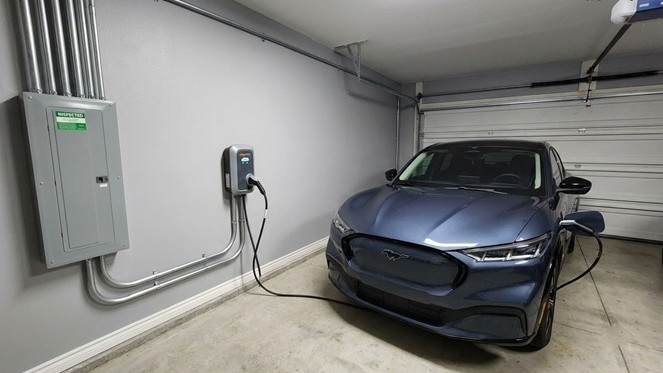
How Much Does It Cost to Install a Mach-E Charger on a 100 Amp Panel?
There is no honest single U.S. average that survives contact with a 40-foot conduit run, a full panel, and a city permit office.
Major cost factors:
- EVSE hardware
- Cable, conduit, and routing distance from panel to parking stall
- Indoor vs. outdoor, surface vs. buried
- Labor rates
- Panel work (new breaker, rearranging circuits, replacement panel if obsolete)
- Permits and inspection
- Load-management equipment or current sensors
- Utility fees
- A service upgrade, if required — often a much larger project than the charger itself
A short garage run with spare capacity can be a relatively contained job. A meter-main replacement and 200-amp upgrade is a different budget class. Ask for a site visit and a written scope. Treat internet “average install prices” as entertainment unless they match your wall distance, panel type, and city.
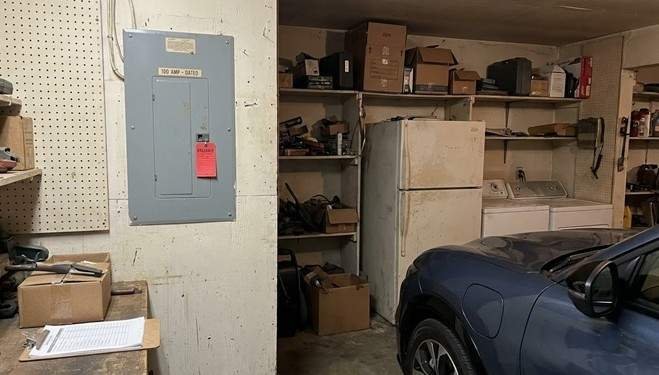
Signs Your 100 Amp Electrical Service May Need an Upgrade
These are reasons to get an evaluation, not proof you must upgrade:
- High existing demand and an all-electric or near-all-electric house
- Multiple large 240-volt appliances
- Electric furnace or heat-pump backup strips
- A second EV already in the driveway or on the calendar
- A panel that is full, outdated, or in poor condition
- Planned induction range, hot tub, shop equipment, or battery storage
- Frequent breaker trips or lights dimming under load (inspect, do not ignore)
- An electrician’s load calculation that does not support the charge rate you need
Condition and capacity are different. A 100-amp panel in excellent shape can still be full of load. A 200-amp panel in poor shape can still be the wrong place to land an EVSE until it is repaired.
Common Mustang Mach-E 100 Amp Charging Mistakes to Avoid
- Assuming every 100A home has the same available capacity. Gas vs. electric heat changes the whole story.
- Choosing a charger from its maximum amperage. Buy the rate the house and the car will actually use.
- Ignoring existing household loads. The dryer does not pause because the Mach-E is stylish.
- Confusing charger amperage with circuit requirements. Continuous-load sizing is not “40A charger, 40A breaker” by hobbyist logic.
- Assuming a 200A upgrade is automatically required. It is not. It is also not automatically avoidable.
- Ignoring future EV ownership. Today’s 48A dedicated circuit can be tomorrow’s dead end.
- Using unsuitable extension cords or adapters. If the cord will not reach, fix the installation.
- Attempting electrical panel work without qualifications. Main services kill people and burn houses.
- Ignoring local code and permitting. Unpermitted EV circuits become home-sale and insurance problems.
- Skipping a professional evaluation. Forums cannot see your heat strips.
Frequently Asked Questions
Can I charge a Mustang Mach-E with a 100 amp panel?
Often, yes — at Level 1 or at a Level 2 rate the house can spare. The 100-amp label does not guarantee a 40A or 48A wall charger. Have the existing load evaluated, then pick a charge rate that fits remaining capacity, your daily miles, and applicable electrical requirements.
Do I need a 200 amp panel for a Mustang Mach-E?
Not necessarily. Many Mach-E owners charge on 100-amp service with Level 1 or moderate Level 2. A 200-amp upgrade becomes relevant when the calculated load is too high, the panel is inadequate, or you want headroom for electric heat, a second EV, or other large additions.
Can I use a 40 amp charger on a 100 amp service?
You can in some homes if the load calculation supports that continuous draw and the circuit is installed correctly for the listed EVSE. A 40-amp charging rate is a major load on 100-amp service. It is not automatically approved because the main breaker is larger than 40.
Can I use a 48 amp charger on a 100 amp panel?
Only if that specific house has the spare capacity, the vehicle will use the current, and the installation meets manufacturer and electrical requirements. 48A at 240V is about 11.5 kW — a large slice of a 100-amp service. Many 100A homes are better served by a lower rate or load management.
Can I use a NEMA 14-50 outlet for a Mustang Mach-E?
A properly installed, dedicated, listed 14-50 used with manufacturer-approved EVSE is a common plug-in Level 2 approach. It does not bypass capacity limits. Do not share it with other appliances, and do not treat a loose RV outlet as an EV charger. Hardwired EVSE is the other standard path.
Can I charge the Mach-E overnight on a 100 amp panel?
Usually, if overnight hours cover the kWh you used at the rate you can run. Short commutes often work even at Level 1. Long daily miles may need Level 2 and a panel that can support it. Starting state of charge and weather matter as much as the clock.
Can I charge two EVs with a 100 amp service?
Yes with a plan: sequential charging, load sharing, mixed Level 1/Level 2, or staggered schedules. Two unmanaged maximum-rate Level 2 sessions plus normal household loads is the scenario most likely to require a service upgrade.
Can load management prevent a panel upgrade?
It can help when the house is near the limit and listed equipment can throttle charging during peaks. It cannot create capacity that electric heat already consumed. Compatibility, installation, and local requirements still apply.
Should I have an electrician inspect my panel before installing an EV charger?
Yes. A qualified electrician should assess panel condition, spaces, grounding, and load, then design a permitted installation. That step is how you find out whether Level 1, 32A, 40A, 48A, load management, or a service upgrade is the honest path.
A Mustang Mach-E can potentially be charged at home on 100-amp service. Plenty of U.S. houses do it every night. The service rating alone does not decide compatibility, and a Mustang Mach-E home charger on a 100 amp panel is not a yes/no product question.
Existing household demand is the critical variable: heat pump and dryer stacks are a different world from a gas-heat bungalow. Lower-power charging — Level 1 or a moderate 32A Level 2 — is enough for many commuters and is easier on a tight panel. Higher-power 40A or 48A charging needs more leftover capacity and a circuit installed to the EVSE listing and local rules. Load management is worth investigating when you are close to the line. A professional electrical assessment should choose the installation, not a charger box and a hopeful main-breaker comparison.
Related Post