you will get a messy mix of leftover dealer listings, old reveal videos, European models that never came to America, and roadmap slides from a Ford EV plan that no longer matches what U.S. shoppers can buy. That is why this question is harder than it looks. The useful issue is not how many electric Fords were announced. It is which ones a U.S. customer can actually purchase or order in 2026.

Here is the short answer: the Ford EV U.S. buyers can shop with the most confidence in 2026 is the Mustang Mach-E. Commercial customers can still look at the E-Transit. The F-150 Lightning is the model that needs the most careful availability check, because Ford has repeatedly adjusted electric-truck production to demand. A hybrid Maverick, Escape, Explorer, or F-150 PowerBoost is not a fully electric vehicle, even if a dealer groups it with “electrified” inventory.
This guide breaks down the current Ford EV lineup 2026 shoppers should actually consider, what each vehicle is good at, how range and charging work in real use, what ownership costs look like, and how to tell a buyable Ford EV from a delayed project or an old announcement.
Ford Electric Vehicles Available in the U.S. in 2026
Ford’s U.S. battery-electric story in 2026 is narrower than the internet implies. That is not automatically a bad thing. A smaller, currently sold lineup is easier to evaluate than a slideshow of vehicles that are not on dealer lots.
Use this overview as a starting point, then confirm the window sticker, order guide, and Ford.com listing for the exact vehicle in front of you. Ford has changed EV pricing, packaging, production volume, and charging hardware more than once. Treat any number that is not on an official 2026 window sticker as a guide, not a guarantee.
| Ford EV | Vehicle type | U.S. availability | Starting price / MSRP | EPA-estimated range | Best suited for |
|---|---|---|---|---|---|
| Mustang Mach-E | Electric crossover SUV | Available to U.S. retail customers as a current Ford EV | Confirm current 2026 MSRP on Ford.com; pricing has moved several times | Varies by battery, drivetrain, wheels, and trim; Mach-E is Ford’s longest-range consumer EV | Daily driving, families who can charge at home, buyers who want an electric SUV |
| E-Transit | Electric cargo van | Available mainly through Ford Pro / commercial channels | Commercial pricing; confirm with Ford Pro or a commercial dealer | Much lower than Mach-E; built for local routes, not cross-country trips | Fleets, delivery, trades, campus and municipal work |
| F-150 Lightning | Electric pickup | Production- and inventory-dependent; verify current order/stock status before assuming a 2026 truck is available | Confirm with Ford and the selling dealer | Use the specific window sticker; truck range changes sharply with wheels, battery, and load | Shoppers who need an electric truck and can confirm actual availability |
In plain English, Ford is not offering a broad American menu of electric cars, crossovers, trucks, and vans in 2026. The consumer-facing Ford electric SUV 2026 shoppers can evaluate in a normal way is the Mach-E. The Ford electric van 2026 commercial buyers can evaluate is the E-Transit. The Lightning still matters to truck shoppers, but it should be handled as a separate availability question, not as a default “yes, every dealer has one.”
That distinction is the whole point of shopping Ford EVs in the USA this year. Availability, not old marketing, decides what you can actually bring home.
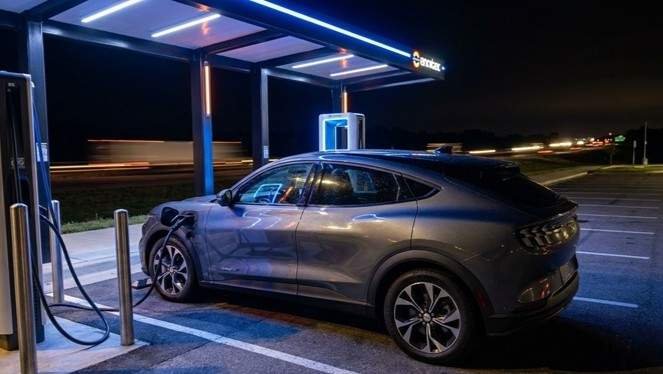
2026 Ford Mustang Mach-E
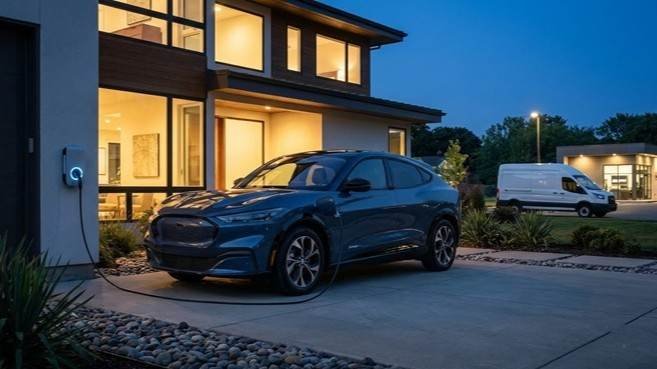
The 2026 Ford Mustang Mach-E is a battery-electric crossover, not a two-door Mustang with a gasoline V8. It looks sportier than a typical compact SUV, sits five people, and is the Ford electric vehicle most U.S. households would actually live with. If you want a Ford EV for commuting, school runs, errands, and the occasional road trip, this is the model to study first.
Ford has sold the Mach-E long enough that the 2026 version is best understood as a current-generation electric SUV with ongoing updates, not a brand-new architecture. Trim names and option packages can change, so confirm the 2026 order guide. In broad terms, shoppers still choose among a more affordable daily-driver version, a better-equipped version, and performance-oriented versions. Rear-wheel drive is usually the efficiency play. Dual-motor all-wheel drive adds weather security and stronger acceleration, at some cost to range.
Battery choice matters more than horsepower on a spec sheet. A standard-range pack is for shorter days and reliable home charging. An extended-range pack is the one to want if you take highway trips or simply hate range anxiety. Ford Mustang Mach-E 2026 range is not one number. EPA estimates change with drivetrain, wheel size, tires, and aero. A version with big performance wheels will not match a range-focused setup. That is normal. The number on the window sticker is a standardized estimate, not a promise that you will see the same miles in January headwinds with the heat blasting.
What those range figures mean in everyday driving is simpler. If your round-trip commute is 40 to 60 miles and you can plug in at home, almost any Mach-E is oversized for the job. The extra battery becomes useful on Friday-night highway drives, weekend trips, and cold weeks when cabin heat and lower battery efficiency take a bite out of the estimate. If you regularly drive 200-plus highway miles between charging opportunities, the extended-range Mach-E is the one that makes the car feel ordinary instead of logistical.
Performance differences are easy to feel and easy to overbuy. Dual-motor versions are quick in the way modern EVs are quick: silent, immediate, and stronger than the body style suggests. The GT-style Mach-E is the one for buyers who care about that. It is not the one to buy if you want maximum miles per charge, quieter running costs, or kinder tire wear. A Rally-style or more rugged setup, if offered in the 2026 mix you are shopping, trades some efficiency for extra ride height and all-weather attitude. Fun, but not free.
2026 Mach-E charging is the ownership feature that decides whether the car is convenient or annoying. At home, a 240-volt Level 2 charger is the difference between “I never think about fuel” and “I am managing a gadget.” Overnight charging covers a normal American driving day. A 120-volt household outlet can add a useful trickle for short commutes, but it is a backup, not a plan. On the road, DC fast charging is what you use for long trips. Peak kilowatt ratings get advertised because they sound impressive. What you should care about is the charging curve: how quickly the battery fills from a low state of charge to about 80 percent, and how much that slows after that. For a 500-mile trip, you will stop. The Mach-E is usable on that trip if fast chargers exist on your route and you are willing to pause for a meal-length charge. It is a poor choice if your idea of a road trip is one stop for coffee and nothing else.
Ford’s move toward Tesla’s NACS connector is part of the 2026 charging picture. Newer Ford EVs have been shifting in that direction so Supercharger access is less awkward than it was in the adapter era. Exact port hardware depends on the vehicle you are buying, so look at the car, not a 2023 explainer. If you are shopping an older leftover Mach-E, you may be looking at a different connector and adapter situation than a newly built 2026 car.
Inside, the Mach-E is a crossover with a big screen, a lower dash than some rivals, and enough passenger space for adults in front. Rear-seat comfort is acceptable for families, not limousine-like. Cargo space is one of the better arguments for the vehicle: a regular hatch plus a front trunk. That front trunk is not huge, but it is useful for charging cables, groceries you do not want sliding around, or weekend bags. Fold the rear seats and it becomes a genuine household hauler. It will not swallow lumber like a pickup. It will handle Costco, strollers, and luggage.
Driver-assistance features are part of the pitch, including adaptive cruise and lane-centering systems that Ford has bundled under its BlueCruise brand on equipped vehicles. Hands-free highway assistance, where available and where mapped, can make a long freeway grind less tiring. It is still a supervised system. It does not make the car self-driving, and buyers should look at the exact 2026 package rather than assuming every Mach-E has the same software and subscription terms.
Who should consider it: anyone who wants a Ford electric SUV 2026 can actually buy, can charge at home or at work, and does not need a bed or commercial cargo volume. Who should think twice: apartment dwellers with no reliable charging, frequent long-distance towing customers, and shoppers whose budget only works if a large federal tax credit is still attached. That credit has never been something to assume. Eligibility rules change. Confirm the vehicle and your household against current IRS and fueleconomy.gov guidance.
The Mach-E’s main disadvantages are familiar. It is not a three-row SUV. Public charging can still be inconsistent. Performance trims cost more to shoe and insure. And because Ford’s broader EV plan has shifted, some buyers worry about residual values and future support. The counter is practical: the Mach-E is a real, in-production Ford with an established service network, not a concept.
2026 Ford E-Transit
The 2026 Ford E-Transit deserves its own section because it is not a lifestyle EV. It is a Ford electric commercial vehicle. Compare it with the Mach-E and you will draw the wrong conclusion. One is a family crossover. The other is a work van that happens to plug in.
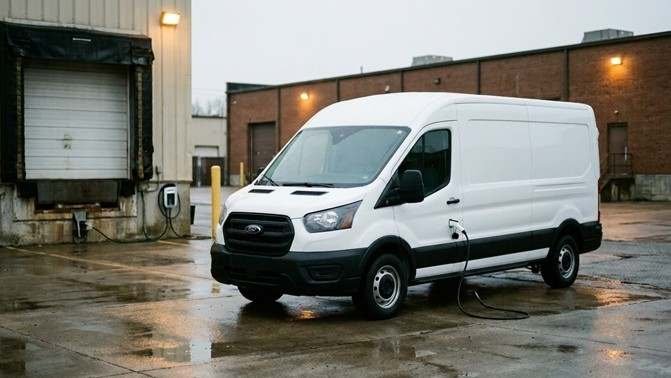
Ford built the E-Transit for fleets, municipalities, delivery operators, contractors, and businesses with repeatable local routes. That design brief shows up everywhere: cargo configurations, upfit potential, telematics, and a range target that would look disappointing in a suburban SUV and perfectly rational for a day of stop-and-go city work.
Available configurations have included cargo van body styles and cutaway/chassis-cab setups for companies that add their own box, service body, or specialty equipment. Exact 2026 configuration availability belongs on Ford Pro’s current commercial pages, because fleet catalogs change by roof height, length, GVWR, and upfit. The buying process is also different. Many E-Transit shoppers are not browsing a consumer showroom the way Mach-E buyers are. They are working through Ford Pro, a commercial dealer, or a fleet order.
Ford E-Transit range should be judged against the route, not against a road-trip SUV. An electric van is heavy, tall, and often packed with tools, parts, or parcels. Highway speed, payload, heating, air conditioning, and repeated door-open cycles all cut into the estimate. If the van returns to a depot every night and the longest run is a metro delivery loop, a modest EPA number can still be the right tool. If your “van” needs to cover rural service calls 180 miles apart, the E-Transit is the wrong product, electric or not.
Charging follows the same logic. A business that can install depot Level 2 charging, or a mix of Level 2 and DC fast charging, can make the E-Transit boring in the best way: leave, work, return, plug in. A contractor who parks on the street and has no charging plan will hate it. Peak public DC fast-charging speed matters less here than whether the vehicle can recover enough energy overnight to start the next shift full.
Payload and cargo are the real spec sheet. An electric van’s battery uses weight you might otherwise spend on payload. That does not make the E-Transit unusable. It does mean a buyer should compare GVWR, cargo volume, and payload against the actual load, not against a gasoline Transit memory. If you regularly max out a gas van, do not assume the electric version is a one-for-one swap.
Work-use practicality is strong when the duty cycle fits. Quiet operation is better in residential neighborhoods. Instant torque helps with low-speed work. Reduced oil-change routines matter when you run vehicles every day. Ford’s commercial software and upfit ecosystem matter as much as the motor. This is a tool. The interior is a workplace.
Who should buy it: a business with predictable mileage, overnight parking, and a charging budget. Who should avoid it: families, road-trippers, and anyone hoping a van EPA sticker will behave like a Mustang Mach-E 2026 range figure. It will not.
What About the Ford F-150 Lightning in 2026?
This is the question that trips people up, so it needs a direct answer: do not assume the 2026 F-150 Lightning is as easy to buy as a gas F-150, and do not assume from an old review that Ford is flooding every dealer with new electric trucks.

The Lightning was the most visible proof that Ford could electrify America’s best-selling vehicle type. Then demand, pricing, charging realities, and Ford’s own profitability targets caught up with the hype. Ford has adjusted Lightning production more than once to better match orders and inventory. That is the key 2026 shopping fact. The truck’s status is not identical to the early launch years, when the story was reservations, allocation, and novelty.
Can customers buy or order one in 2026? Possibly, depending on remaining inventory, current production, and what Ford is actually taking orders for at the time you shop. That is not a dodge. It is the accurate way to describe a vehicle whose output has been managed rather than treated as an unlimited retail staple. Before you fall in love with a configurator screenshot from two years ago, do three things:
- Check Ford’s official U.S. site for current Lightning order/availability status.
- Call more than one dealer and ask whether they have new 2026 trucks, leftover prior-year stock, or no electric F-150 at all.
- Read the window sticker on the exact truck. Battery size, wheels, cab/bed configuration, and options change range and price enough that “the Lightning” is not one product.
Existing inventory can differ from a newly produced vehicle in software, charging connector, option bundles, and price. A dealer listing for an electric F-150 is not automatically a 2026 model, and a 2025 leftover is not automatically a worse idea. It may even be the more realistic buy if Ford is not building the truck in the volume shoppers expect. Just know what you are looking at.
What happened to the earlier Lightning strategy is less mysterious than social media makes it. Ford discovered, as other automakers did, that a large, expensive electric truck is a specialized purchase. It makes sense for buyers with home charging, local jobsites, and a need for onboard power. It makes less sense for buyers who tow long distance every weekend or who have no place to plug in. Ford’s later public comments and production changes reflected that, along with a broader shift toward hybrids in trucks where customers still wanted gas-station flexibility.
How shoppers should interpret dealer listings: slowly. Confirm model year, battery, miles if it is a demo, whether the price is before incentives that may no longer exist, and whether the truck is actually on the lot. If a salesperson talks about the Lightning as if it is as orderable as an XLT 2.7-liter F-150, ask them to pull the current order bank. Availability is the feature.
Ford EVs That Are Not Actually Available to Buy in 2026
Ford’s problem, from a shopper’s point of view, is not a lack of imagination. It is that announcements travel farther than production. A vehicle can be announced, planned, delayed, rumored, shown in Europe, or built as a concept without being a 2026 U.S. retail product.
Announced means Ford has talked about it. Planned means it had a timeline. Delayed means that timeline moved. Rumored means you should ignore it until Ford puts the vehicle in a U.S. order guide. Currently available means a customer in the United States can buy or order it through normal Ford or Ford Pro channels.
That filter knocks out a lot of confusion. European Ford electrics such as models sold around the Explorer EV / Capri / Puma space are not the U.S. lineup. A next-generation electric pickup Ford has discussed for later in the decade is not a 2026 showroom truck. An affordable mass-market Ford EV that was talked about when every automaker promised a $25,000 to $30,000 car is not sitting at your local dealer waiting for a weekend test drive. A three-row electric Ford SUV that existed in earlier product-plan coverage is not something to shop as if it were a 2026 Mach-E alternative unless Ford is actually selling it in the United States. As of the current U.S. retail picture, buyers should not count on a new, widely available three-row Ford BEV.
Lincoln vehicles are a separate brand. Concepts, one-off performance vans, and auto-show specials are not inventory. Old articles about “Ford’s incoming EV onslaught” are historical documents. They are not a 2026 buying guide.
If a vehicle is not on Ford’s current U.S. site with retail or fleet availability, treat it as unavailable. That single habit will save you from planning your next car around a press release.
Ford Electric Vehicles 2026: Range Compared
EPA range is a lab-based estimate designed to let you compare vehicles, not a guarantee of the miles you will get on Tuesday. Real-world range moves with speed, temperature, wind, hills, load, wheels, and how hard you use climate control. Anyone who tells you a Ford EV “always” delivers a particular number is selling certainty the battery does not offer.
Among Ford’s current fully electric products, the Mach-E is the long-range choice for civilians. That is the practical comparison. The E-Transit is a local-work vehicle. The Lightning, when you can find one, sits in the truck world, where aero, tires, and payload punish estimates faster than a crossover does.
Cold weather is the first reality check. Batteries deliver less effective range when they are cold, and cabin heat is no longer “free” waste energy from a combustion engine. A Mach-E that feels effortless in May can feel tighter in a Minnesota January, especially on a highway with a headwind. Preconditioning the battery and cabin while the car is still plugged in helps. It does not repeal physics.
Highway driving is the second. EPA estimates blend city and highway. Sustained 75 mph is harder on an EV than stop-and-go traffic, because air resistance rises fast and regenerative braking helps less. If your life is a 70-mph commute, shop the extended-range Mach-E and mentally discount the sticker a bit. If your life is suburban errands, the sticker is more generous than you need.
Towing and load are the third. Tow a trailer and range can fall off a cliff. Fill an E-Transit with freight and the same thing happens, just from a lower starting point. This is why “Ford EV range” has to be paired with a use case. A number without a job is trivia.
Climate control, wheel size, and state of charge round out the picture. Big wheels look better and often cost miles. Using the last 10 percent of the battery is not the same as using the middle 60 percent. Many drivers will fast-charge up to about 80 percent on trips because the last slice is slower. That means the usable road-trip range is less than the EPA number even before weather shows up.
So what does this mean for you? If home charging covers your weekday miles with a buffer, range is a feature you buy for weekends and peace of mind. If you cannot charge at home and you live on the highway, range is the whole product, and a Ford hybrid may fit better than any Ford BEV.
How Fast Do Ford EVs Charge in 2026?
Charging jargon is the part of Ford EV ownership that makes gasoline shoppers feel like they missed a class. The concepts are simpler than the vocabulary. Level 1 is a standard 120-volt wall outlet. It is slow. On a Mach-E, it may add a modest number of miles overnight. Fine for a very short commute. Not fine as your only plan if you drive an average American day.
Level 2 is 240-volt charging, the same family of power as a dryer outlet, usually through a home charger or a public pedestal. This is the Ford EV home charger setup that makes electric ownership easy. You plug in when you park. You leave with enough range. Ford EV Level 2 charging is what most owners should budget for, either with a Ford-branded station or a compatible third-party unit installed by a qualified electrician. Panel capacity, permitting, and install cost vary by house. The car is the easy part. The house is the project.
DC fast charging is public, high-power charging for trips. You do not use it the way you use a home plug. You use it to add a lot of miles in 20 to 45 minutes, depending on the charger, the car, the battery temperature, and how empty the battery was when you arrived. Ford EV charging time is not “15 minutes, always,” even if a peak kW number sounds like that. Peak power is a crest, not a plateau. Batteries accept faster charge when they are low and warm, then they taper. A crowded station, a 50 kW unit advertised as “fast,” or a cold battery can turn a planned 25-minute stop into 40.
Connector and network compatibility matter more in 2026 than they did when Ford EVs were new. Ford has been aligning with NACS and Tesla Supercharger access, while earlier cars and some public stations still revolve around CCS. Buy the car in front of you, then set up the right apps and accounts. Do not assume every stall on a road-trip map will fit, work, or deliver the number on the sign.
What an average owner actually needs is almost boring. A 240-volt home charger. A workplace charger if possible. A fast-charging plan for a few trips a year. If that mix is available, Ford electric vehicle charging time becomes a background task. If it is not, you will spend your ownership thinking about plugs instead of driving.
How Much Does It Cost to Own a Ford EV?
The lazy line is that EVs are cheaper. Sometimes they are. Sometimes they are not. It depends on the purchase price, local electricity, how much you drive, insurance, tires, and how hard the vehicle depreciates.
Purchase price still comes first. Ford EV prices have been volatile. Ford has cut prices, added and removed credits in the transaction, and changed which trim is the “real” starting point. That means a 2023 think piece about Mach-E value may be useless in 2026. Get a current out-the-door quote. Do not shop from memory.
Electricity costs replace gasoline, but they are not one national number. Home charging in a cheap-electricity state can make a Mach-E inexpensive to drive. Public charging, especially DC fast charging on a road trip, can be as costly as premium fuel on a per-mile basis. If you will rely on public chargers every day, run the math before you buy. The EV advantage is largest when most charging happens at home at off-peak rates.
Routine maintenance is where EVs usually win. No oil changes, no spark plugs, less brake wear if you use regenerative braking. You still have cabin filters, tires, brake fluid, wiper blades, and coolant loops. You still have 12-volt battery issues on some EVs, because the car is not magic. Tires can be a hidden cost, especially on heavier vehicles and performance wheels. A Mach-E GT-style setup will not be cheap to keep in rubber.
Insurance and registration vary by state and by driver. Some insurers price EVs higher because parts and sensors are expensive. Some states have EV registration fees meant to replace lost gas-tax revenue. Ask for an insurance quote on the exact VIN or trim before you sign.
Depreciation is the uncomfortable one. Many EVs, Ford’s included, have had rockier resale than shoppers expected in the peak-hype years. Price cuts on new vehicles made older ones look expensive overnight. If you buy and keep the car for a long time, that matters less. If you like to trade every three years, it matters a lot.
Battery warranty, discussed below, is part of the financial picture, but it is not a prepaid replacement plan for a battery that has simply lost some range. Unexpected repairs on power electronics, charging ports, or driver-assistance sensors can be costly outside warranty. Ford’s dealer network is a genuine advantage over a startup EV brand. It is not a promise that every independent shop in town is ready.
Actual ownership cost is local. Ten cents per kilowatt-hour and a short commute is one story. Thirty-five cents public charging and 18,000 annual miles of mixed highway driving is another.
Ford EV Battery Warranty and Long-Term Ownership
Ford’s high-voltage battery coverage on its electric vehicles has typically been 8 years or 100,000 miles, whichever comes first, under the company’s current-generation EV warranty structure. The rest of the vehicle still has separate bumper-to-bumper and powertrain terms, which have commonly been shorter. Always read the warranty guide that comes with the specific 2026 vehicle, because coverage details, transfer rules, and any capacity thresholds are in the document, not in a blog.
A warranty is not a guarantee that the battery will be as strong in year eight as in week one. Batteries degrade. That is expected. Warranty language is about defects and, where specified, capacity falling below a covered threshold. Degradation is not the same as failure. A Mach-E that loses some range over years of fast charging and hot-weather parking can still be a perfectly usable car. A battery that fails to hold adequate capacity or suffers a covered defect is the warranty case.
This is why “Ford EV battery” conversations should stay calm. You are buying a wear-sensitive energy pack with a long but finite coverage window. Storage habits matter. Repeatedly keeping the battery at 100 percent, or repeatedly hammering DC fast chargers in extreme heat, is not the gentlest life. Daily charging to a moderate level, with 100 percent reserved for trips, is the grown-up approach many owners adopt.
EV maintenance is different from gasoline maintenance, not absent. Technicians need high-voltage training. Software updates can change charging behavior and driver-assistance features. That can be a benefit. It also means the car you own in year four may not behave exactly like the car you test-drove. Ford’s advantage is that you are not depending on a thin service footprint. The limitation is that not every Ford store has been equally good at EV diagnosis. Ask where the certified technicians actually are.
Do not buy any Ford EV because someone promised the battery will last a specific number of years beyond the warranty. Ford does not owe you that, and neither does a stranger on a forum.
Ford EV vs Ford Hybrid in 2026
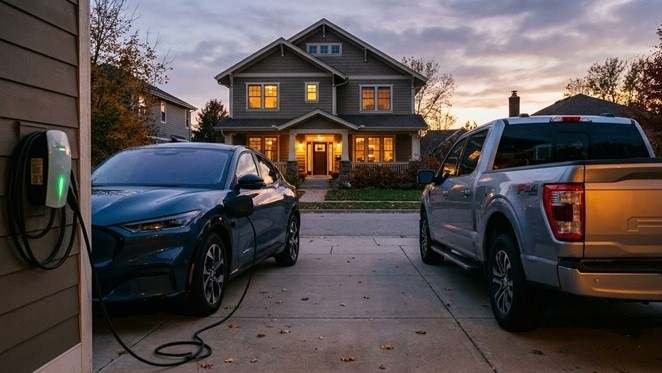
This may be the most important decision in the article. Ford is selling both fully electric vehicles and hybrids. They solve different problems. A hybrid is not a fully electric vehicle. A plug-in hybrid is not a BEV either, even if it can cover a short commute on electricity.
Ford EV advantages are obvious when the infrastructure fits. Quiet drive. Strong low-speed torque. Home refueling. Lower routine maintenance. The ability to start every morning at “full” without standing at a pump. For a Mach-E household with a garage charger, weekday life can be simpler than gasoline life.
Hybrid advantages show up everywhere an EV is awkward. No home charger? A Maverick hybrid or Escape hybrid still works. Frequent 400-mile days through rural charging gaps? An F-150 PowerBoost or another Ford hybrid keeps the trip familiar. Towing long distances, winter cabin heat without a big range penalty, instant fuel availability, and generally stronger resale in some truck segments all favor hybrids for a lot of Ford customers. That is a big reason Ford’s strategy now puts more weight on hybrid trucks and SUVs instead of treating every vehicle as an EV waiting to happen.
Home charging is the fork in the road. If you cannot install it and you do not have reliable workplace charging, a Ford EV becomes a public-charging lifestyle. Some people accept that. Many will not. Long-distance driving is the second fork. EVs can road-trip. They just road-trip on a charger map. Hybrids road-trip on the same gas stations you already use.
Towing and work use are the third. A Lightning can tow and can supply jobsite power, which is genuinely useful. Range while towing is the catch. A hybrid F-150 remains the more flexible all-around truck for mixed towing and travel. An E-Transit is excellent at the right commercial loop and a poor substitute for a long-range family SUV.
Operating costs depend on fuel and electricity prices in your county, not on national averages. Lifestyle is the honest closer. If plugging in sounds like a chore, do not buy the EV to perform environmental identity. Buy the hybrid, or the regular gas Ford, and be done.
Which Ford Electric Vehicle Is Best for You?
There is no universal winner. There is a best fit.
Best Ford EV for Daily Commuting
The Mustang Mach-E. It is the 2026 Ford EV models choice that matches commuting: car-like size, enough range, lower running costs if you charge at home, and a dealer network that already knows the product. Choose rear-wheel drive and a sensible wheel if efficiency matters more than launch feel.
Best Ford EV for Families
Again the Mach-E, with the practical trims rather than the performance ones. You get five seats, a hatch, a front trunk, and enough tech to keep the trip manageable. It is not a three-row hauler. If you need third-row seating every week, a Ford EV is the wrong family answer in 2026. Look at a hybrid three-row Ford or another brand’s available three-row EV rather than forcing the Mach-E to be an Expedition.
Best Ford EV for Business
The E-Transit, provided the routes and depot charging work. For a business that needs a truck bed and onboard power, a Lightning can be the tool — if you can actually get one and the mileage fits. Do not buy a Mach-E as a fake work truck.
Best Ford EV for Long Road Trips
The extended-range Mach-E, with route planning and patience. It has the best combination of Ford EV range and passenger comfort in the currently shoppable U.S. lineup. It still needs working DC fast chargers. If your trips are frequent, rural, or tightly timed, a hybrid remains the less fragile choice.
Best Ford EV for Performance
The performance Mach-E variants, if they are in the 2026 offering you are shopping. They are quick. They are also the versions most likely to cost you range, tires, and insurance. Buy one because you want the way it drives, not because it is the “best” Ford EV in any broader sense.
What Makes Ford’s 2026 EV Strategy Different?
A few years ago, Ford talked about electric vehicles as a wave that would remake the company quickly: Lightning volume, new factories, new nameplates, an aggressive consumer EV push. The 2026 reality is more cautious. Consumer EV demand grew, then got choosier. Price-sensitive buyers hesitated. Charging infrastructure improved without becoming universally easy. Ford lost a lot of money on EVs and said so. Profitability stopped being a later problem and became the problem.
The manufacturing and product response has been to build fewer of the wrong EVs, keep the models that have a real audience, and put more energy into hybrids that customers will actually purchase at scale. That hybrid/EV balance is the strategy. It is why the U.S. Ford EV lineup 2026 looks smaller than old coverage promised, and why an F-150 with a hybrid system may be a bigger 2026 story for truck buyers than another electric moonshot.
Affordability is still unfinished business. Ford has cut EV prices before, but a truly cheap Ford electric car for the U.S. mass market is not the 2026 headline. Charging infrastructure remains a shared industry problem: better than 2021, still uneven. Future Ford EV plans should be treated as future plans. Interesting. Not shopable.
None of this requires a morality play. Ford is selling what it can sell more sustainably as a business. Shoppers should do the same at household scale.

Should You Buy a Ford Electric Vehicle in 2026?
Buy a Ford EV in 2026 if the car you can actually get matches the life you already live. That usually means a garage or driveway with a 240-volt charger, a daily mileage pattern the battery covers with room to spare, only occasional road trips, and a budget that works without pretending incentives will paper over a too-expensive trim.
The Mach-E is the yes for a lot of those households. The E-Transit is the yes for the right fleet. The Lightning is a maybe that starts with inventory, not desire.
Wait, or choose a Ford hybrid, if you park on the street, drive long rural miles, tow often, need three rows, or only keep cars for a short cycle and worry about EV depreciation. Those are not personality flaws. They are constraints. A hybrid Ford respects them. A BEV fights them.
Vehicle size, expected ownership period, and local charging quality should decide it. A five-year Mach-E owner with cheap home electricity can have a great experience. A two-year lessee who depends on chaotic public charging may not. Neither person is wrong. They are shopping different products.
Frequently Asked Questions
What Ford electric vehicles are available in 2026?
For U.S. customers, the Mustang Mach-E is the main retail Ford EV to shop. The E-Transit is the electric van for commercial users. The F-150 Lightning may appear as inventory or limited production, but you should verify current availability on Ford’s official site and with dealers rather than assuming it is a standard orderable truck.
Does Ford still sell the F-150 Lightning in 2026?
Treat Lightning availability as something to confirm, not something to inherit from earlier model years. Ford has adjusted production to demand. Some dealers may have trucks. Others may have none. Ask for model year, stock status, and whether Ford is currently taking new orders.
What is the longest-range Ford EV in 2026?
In the currently relevant U.S. lineup, the Mustang Mach-E is the consumer Ford EV with the range you would actually use for mixed driving and trips. Exact EPA figures depend on battery, drivetrain, and wheels. Check the 2026 window sticker and fueleconomy.gov for the specific configuration.
How much does a 2026 Ford EV cost?
Enough that you should not trust an old starting price. Ford EV prices have been revised repeatedly. Use Ford.com, a written dealer quote, and the window sticker. Commercial E-Transit pricing runs through Ford Pro channels and is not comparable to a consumer Mach-E ad.
How long does it take to charge a Ford EV?
At home on Level 2, you typically recharge overnight and stop thinking about it. On a DC fast charger, a useful trip charge is often a couple of dozen minutes to around 80 percent, then slower after that. Level 1 is much slower. Total time depends on battery size, starting charge, temperature, and the charger’s real output.
Can I charge a Ford EV at home?
Yes, and you should plan on it. A 240-volt Level 2 installer visit is the normal ownership setup. A regular 120-volt outlet can work for very low daily mileage. If you cannot charge at home or work, think hard before buying.
Does Ford offer an electric SUV in 2026?
Yes. The Mustang Mach-E is Ford’s electric SUV for the U.S. market. It is a two-row crossover, not a three-row family hauler.
Does Ford make an electric van?
Yes. The E-Transit is Ford’s electric commercial van. It is for work routes and fleet duty cycles, not family road trips.
Are Ford hybrids considered electric vehicles?
No. Hybrids and plug-in hybrids use electric assistance, but they are not fully electric vehicles. If you need a gasoline pump as backup, you are not shopping a BEV.
Is a Ford EV worth buying in 2026?
It can be, if you can charge where you park, the Mach-E or E-Transit fits the job, and the math works in your state. It is not automatically worth it because the badge says electric. Match the vehicle to charging access, mileage, and how long you will keep it.
Ford electric vehicles 2026 should be judged by what U.S. buyers can actually purchase, not by the leftover glow of old EV roadmaps. The Mach-E is the Ford EV that still makes sense as a household electric SUV. The E-Transit makes sense as a depot-charged work van. The Lightning is a truck you verify, truck by truck. Everything else is either a hybrid, a future product, a European model, or a memory.
If you have home charging and a two-row electric crossover is enough, shop the Mustang Mach-E and ignore the noise. If you run local commercial routes, shop the E-Transit as a tool. If you need a bed, confirm Lightning stock with your own eyes. If you cannot plug in, stop forcing the EV answer and look at a Ford hybrid. That is the practical way to read Ford’s 2026 EV lineup — and the only way that matches the cars that are really for sale.
Related Post