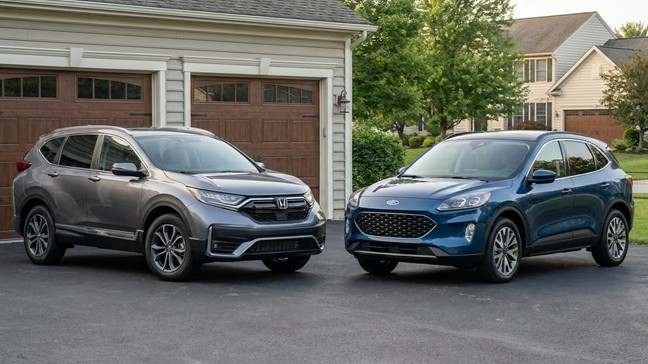
There is no Ford CR-V. Honda makes the CR-V. Ford never sold a vehicle by that name in the United States. If you typed ford crv into Google, you are not looking at a missing brochure page. You are looking at a mix-up that happens constantly: Honda’s compact SUV is so common that shoppers attach the CR-V name to whatever brand they actually meant to research. Most of those searches are really asking one of three things. Does Ford build a CR-V? What Ford is the Honda CR-V’s rival? And which Ford compact SUV should I test if I like the CR-V but want a Blue Oval dealer?
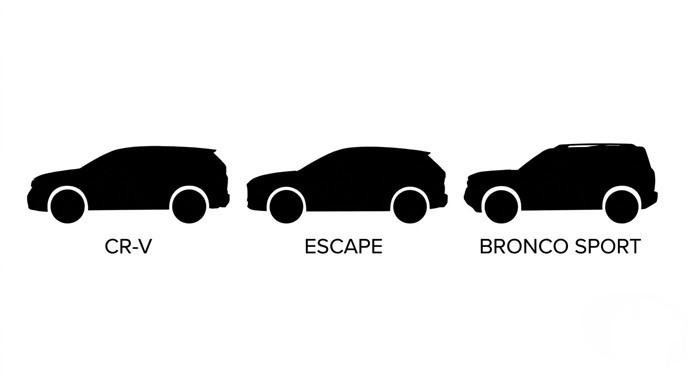
The short shopping answer: Honda owns the CR-V name. Ford’s longtime compact-crossover rival was the Escape. Ford’s remaining compact SUV with a clear U.S. identity is the Bronco Sport. Neither is a CR-V. Both overlap it in size, price, and family use — in different ways. Confirm current new-vehicle availability on Ford.com and Honda.com before you shop. Ford has been shrinking traditional car-based crossovers. A leftover Escape, a Bronco Sport, and a used Escape are not the same purchase.
Does Ford Make a CR-V?
No. The CR-V is a Honda compact SUV, sold in the U.S. since the 1997 model year. The name is Honda’s. It is not a Ford trim, a Ford export badge, or a discontinued Ford that dealers still have in a warehouse.
Ford’s U.S. SUV names are familiar on their own: Bronco, Bronco Sport, Escape (where still offered or in leftover/used inventory), Explorer, Expedition, and the electric Mustang Mach-E. None of them is called CR-V. That is the literal answer. The useful answer is what you probably wanted next.
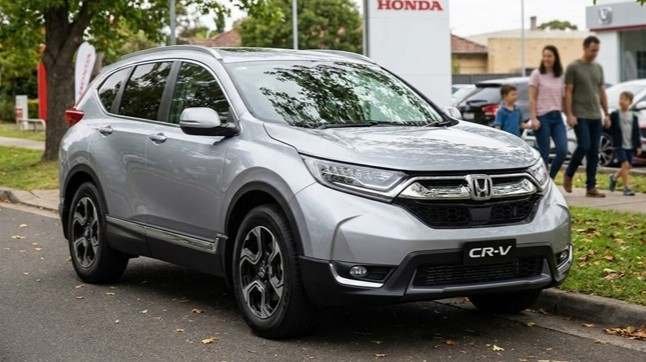
What Is the Ford Equivalent of the Honda CR-V?
There is no one-for-one Ford CR-V equivalent, because Ford and Honda did not build the same vehicle. For most U.S. shoppers, the class equivalent — five-seat compact SUV, FWD or AWD, family cargo, mainstream price — has been the Ford Escape. That is the vehicle Honda CR-V shoppers have cross-shopped for two decades. Same parking-space size. Same school-run job. Different powertrains, cargo shape, and brand habits.
If you are shopping new and the Escape is thin on the lot or already gone from Ford’s current order guide, the compact Ford you can still walk into is usually the Bronco Sport. It is shorter, more off-road in stance, and less of a “soft-road CR-V clone.” It is still the Ford that sits nearest the CR-V in footprint and monthly payment.
Larger Fords are the wrong class:
- Explorer — midsize, often three-row
- Expedition — full-size body-on-frame
- Mustang Mach-E — electric crossover, different fueling life
- Bronco — two- or four-door off-roader, not a CR-V rival
So: Honda CR-V is the Honda. Ford Escape is the traditional Ford rival. Bronco Sport is the compact Ford that remains central if Escape production has wound down in your model year. Used Escapes are everywhere if you like that package and missed the new-car window.
Always match model years. A 2025 CR-V, a 2025 Escape, and a 2026 leftover are not interchangeable spec sheets.

Ford Escape vs Honda CR-V
This is the comparison ford crv searchers almost always need, as long as they understand the Escape is a Ford and the CR-V is a Honda.
Both are five-passenger compact SUVs. Both offer front-wheel drive and all-wheel drive (Bronco Sport is AWD-standard; CR-V and Escape have been FWD-or-AWD). Both have hybrid versions in recent U.S. years. Both sit in the high-$20,000s to $40,000s depending on trim, hybrid hardware, and options. Destination, packages, and dealer pricing change the out-the-door number. MSRP is not what you pay.
Size and space.
The current-generation Honda CR-V (sixth generation, 2023–present) is the roomier-feeling family compact on paper and in the back seat. Honda stretched the CR-V into one of the more adult compact SUVs: roughly 184.8 inches long on a 106.3-inch wheelbase. Recent Escapes have been a bit shorter overall — around 180.5 inches — with a similar wheelbase near 106.7 inches. The CR-V’s advantage shows up in rear-seat kneeroom and a taller, more vertical cargo hold. The Escape often feels easier to place in a tight garage because the bumper-to-bumper length is smaller.
Cargo.
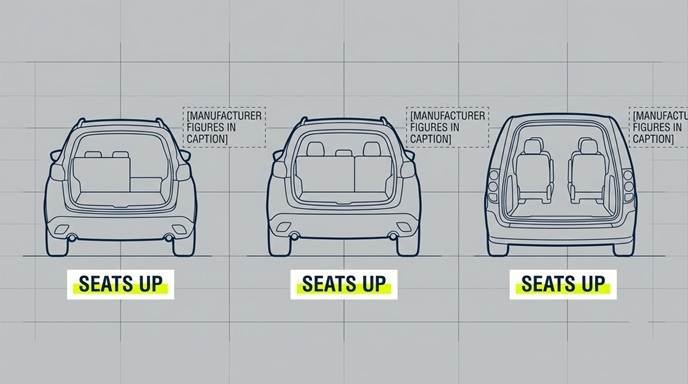
Honda publishes about 39.3 cubic feet behind the rear seats and about 76.5 cubic feet max on gas CR-Vs. Hybrids lose some underfloor/behind-seat volume because of the battery; Honda’s hybrid figure behind the second row is lower (mid-30s). Ford has rated recent Escapes around the mid-30s behind the rear seats and the mid-60s with the seats down — less maximum cube than the CR-V. If Costco-and-stroller space is the decision, measure both with the seats up. Brochure max cargo is a moving-day number.
Power.
Recent U.S. CR-Vs use a 1.5-liter turbo four rated at 190 horsepower and 179 lb-ft, with a CVT, or a hybrid (2.0-liter four plus motors) at 204 horsepower. Recent Escapes have used a 1.5-liter turbo around 180 hp, a 2.0-liter turbo at 250 hp / 280 lb-ft, and a hybrid near 192 hp. The Ford 2.0-liter is the punchier gas engine if you want stronger passing power than a CR-V 1.5T. The Honda hybrid is the efficiency leader in this pairing on EPA labels.
Towing.
Honda rates the CR-V at 1,500 pounds. That is grocery-trailer territory, not a boat. Properly equipped Escapes with the 2.0-liter have been rated as high as 3,500 pounds; the 1.5-liter is lower, often 2,000 pounds. If light towing is why you typed Ford next to CR-V, that gap is real — and it is why some shoppers leave Honda.
Fuel.
Use the window sticker for the exact configuration. Typical recent EPA neighborhoods: gas CR-V FWD in the high 20s/low 30s combined; CR-V Hybrid FWD around 40 mpg combined (Honda has posted 43/36/40 on some FWD hybrid labels). Escape hybrids have also lived in the high 30s to around 40 combined depending on FWD/AWD. Gas Escapes vary widely with the 1.5 vs 2.0 and wheel size. EPA numbers are estimates, not a commute promise.
AWD.
Both offer it. Honda’s system is a weather-and-gravel compact-SUV setup. Ford’s Escape AWD is the same class. Neither is a Bronco. If you want Ford’s more trail-capable compact, that is Bronco Sport, not Escape.
Warranty.
Honda: 3 years/36,000 miles basic, 5 years/60,000 powertrain, plus Honda’s longer-than-Ford hybrid-component story on many hybrids. Ford: typically 3/36 basic, 5/60 powertrain. Read the glovebox warranty book on the vehicle you buy. CPO coverage is a different product.
Infotainment and assists.
Current CR-Vs have a large center screen, Honda Sensing as standard, wireless phone mirroring on many trims, and Google built-in on later hybrids/upper grades depending on year. Recent Escapes use Ford’s digital cluster and touchscreen setup, with Ford Co-Pilot360 driver assists that vary by trim. Do not assume every camera, adaptive cruise, or 4G hotspot is on a base model of either brand.
The fair read: the CR-V is the more consistently family-polished compact. The Escape (when you can still buy one new, or as a late used example) is the Ford that matches the mission, with a stronger optional gas engine and higher possible towing.
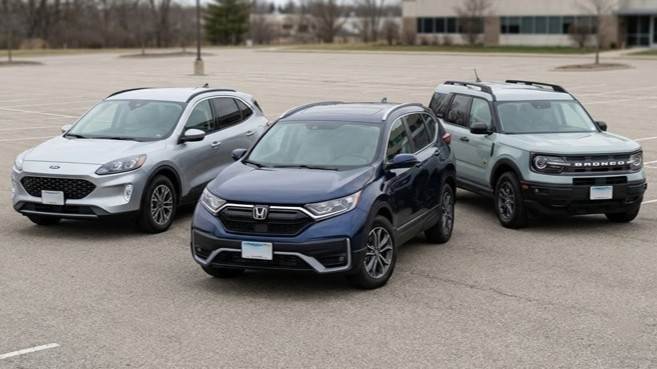
Why Do People Search for “Ford CRV”?
Because the CR-V became generic, the way “Coke” did for soda. People search Ford CR-V when they:
- Know they want a compact SUV and only remember the Honda name
- Are loyal to a Ford dealer and think every brand copies Honda’s badge
- Saw a silver compact crossover and guessed the wrong manufacturer
- Want a Ford that “is like a CR-V”
- Are comparing lease payments and mixed the names in a spreadsheet
- Heard “CR-V hybrid” and assumed Ford sells one too
Ford also used two-letter-plus-V names in other eras (F-150, Expedition — not the same pattern), and Mazda/Ford crossovers shared DNA years ago. None of that produced a Ford CR-V.
The search is a class question wearing the wrong badge.
Honda CR-V vs Ford: Which Ford SUV Is Closest?
Closest in job description: Ford Escape.
Closest compact Ford you can still plan around if Escape is exiting the new-car list: Bronco Sport.
Closest if you wanted Honda’s hybrid mpg and will charge at home instead: Mustang Mach-E is the electric Ford, not a hybrid CR-V clone.
Closest if the CR-V felt too small: Explorer.
Bronco Sport vs CR-V is the comparison lots of 2026 shoppers will actually drive.
Bronco Sport is several inches shorter than a CR-V (about 172.7 inches long). Cargo behind the rear seats is in the low-30s cubic feet, with a maximum in the mid-60s — less family cube than a CR-V. AWD is standard. The 1.5-liter turbo is in the 180-hp class; the 2.0-liter Badlands-style powertrain is 250 hp. Ground clearance, all-terrain tires, and trail modes are the point. Rear-seat room is tighter than the CR-V. If you liked the CR-V because it felt like a small Accord wagon with height, Bronco Sport will feel more like a junior Bronco. If you liked the CR-V but keep driving Forest Service roads, Bronco Sport is the Ford that understands that weekend.
Explorer is a jump in price, fuel use, and parking difficulty. Only go there if you need a third row.

Is the Honda CR-V Bigger Than Ford’s Compact SUV?
Usually, yes — versus both Escape and Bronco Sport — in the ways families feel.
| Measure (typical current-gen figures) | Honda CR-V | Ford Escape (recent) | Ford Bronco Sport |
|---|---|---|---|
| Role | Compact family SUV | Compact family SUV | Compact, more off-road |
| Length | ~184.8 in | ~180.5 in | ~172.7 in |
| Wheelbase | ~106.3 in | ~106.7 in | ~105.1 in |
| Seating | 5 | 5 | 5 |
| Cargo behind rear seats | ~39.3 cu ft gas; less on hybrid | Mid-30s cu ft | Low-30s cu ft |
| Max cargo | ~76.5 cu ft | Mid-60s cu ft | Mid-60s cu ft |
| Rear-seat adult room | One of the class leaders | Competitive, a bit tighter | Tighter, more upright |
| Maneuverability | Easy compact | Slightly easier than CR-V in length | Easiest of the three in a city garage |
The CR-V is not a midsize SUV. It is a large compact. That is why it keeps winning shoppers who sat in a Tucson, RAV4, and Escape and wanted the back seat to fit a rear-facing child seat behind a tall driver.
Bronco Sport is smaller. Escape sits in the middle. If “bigger than a Ford compact” is the whole question, Honda still has the edge in this trio.
Ford CR-V Hybrid: Does Ford Have a Hybrid Alternative?
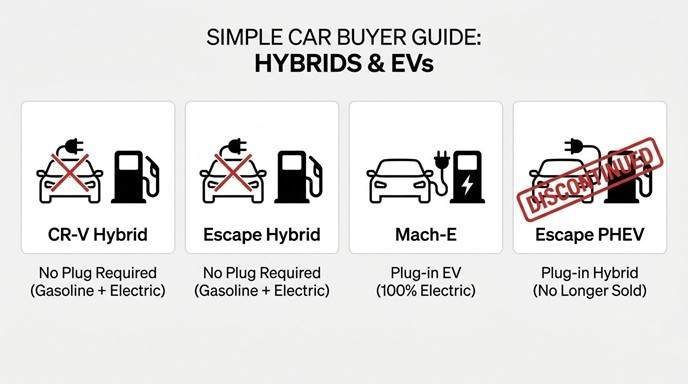
There is no Ford CR-V Hybrid, because there is no Ford CR-V. Honda’s CR-V Hybrid is a conventional hybrid: gasoline engine, electric motors, no plug. Combined output is 204 hp. FWD hybrid EPA labels have been in the 40 mpg combined neighborhood; AWD costs a few mpg. It is the CR-V most efficiency shoppers should drive.
Ford’s hybrid compact has been the Escape Hybrid (about 192 hp combined from a 2.5-liter four and electric assist). When offered, it was the genuine Ford answer to a CR-V Hybrid: same idea, no plug, high-30s to ~40 mpg combined depending on drivetrain. If new Escape Hybrids are gone in your market, the used ones are the Ford hybrid compact that still exists in volume.
Bronco Sport is not a hybrid. Mustang Mach-E is not a hybrid; it is a battery-electric SUV. Ford Maverick Hybrid is a compact truck. Do not let a dealer slide you from “I searched Ford CR-V Hybrid” into a gas Bronco Sport without saying that out loud. Different fuel, different EPA sheet, different oil-change life.
Is There a Ford SUV Similar to the Honda CR-V?
Yes. Similar is not identical.
Most similar overall: Escape, especially a hybrid Escape vs a CR-V Hybrid, or a 1.5T Escape vs a 1.5T CR-V.
Similar in compact Ford clothing, different personality: Bronco Sport.
Similar price, different mission: a base Explorer is usually more money and more vehicle than a loaded CR-V.
What “similar” should mean for a shopper:
- Five seats, not seven
- Compact parking
- 4-cylinder or hybrid, not a V6 truck
- AWD optional or standard
- Cargo for a stroller and Costco, not a full-size cooler wall
- MSRP that starts near $30,000 before they stack packages
That list is Escape and, with less cargo, Bronco Sport. It is not F-150. It is not Expedition.
Honda CR-V vs Ford: Gas vs Hybrid Powertrains
Honda’s gas CR-V is adequate. The 190-hp 1.5-liter turbo and CVT are tuned for smoothness and EPA, not for a 2.0-liter Escape’s midrange. In a two-person commute it is fine. With four adults, AWD, and a roof box, you will use the hybrid’s extra combined torque and wish you had it.
Honda’s hybrid is the CR-V to beat on fuel and around-town snap. It still tows only 1,500 pounds. Ford’s gas story was more split. The Escape 1.5-liter is the volume engine. The 2.0-liter 250-hp Escape is the one that makes a CR-V 1.5T feel flat on a two-lane pass. That Ford four-cylinder is the argument for people who hate CVTs and want a conventional automatic and a higher tow rating.
Escape Hybrid vs CR-V Hybrid is the fair efficiency fight. Honda usually wins the sticker and the reputational hybrid bet. Ford’s hybrid, when you can find one, is close enough that a test drive and a real commute matter more than a 2-mpg EPA gap.
Bronco Sport stays gas-only in the current formula. Budget like a compact SUV that does not sip like a CR-V Hybrid. Electric is a third path. Mach-E range and charging are a different ownership model. Do not treat it as a CR-V Hybrid with a Ford badge.
Which Has More Cargo Space: CR-V or Ford’s Alternative?
The Honda CR-V has more cargo volume than recent Escapes and Bronco Sports in the published max number, and more usable behind-the-second-row space than Bronco Sport.
Behind the rear seats — the number you live with:
- CR-V gas: about 39.3 cu ft
- CR-V Hybrid: lower, typically mid-30s
- Escape: typically mid-30s
- Bronco Sport: typically low-30s
Seats folded:
- CR-V: about 76.5 cu ft
- Escape / Bronco Sport: typically low- to mid-60s
The CR-V’s load floor is lower and more minivan-like than Bronco Sport’s. Bronco Sport’s cargo bay is taller in places and shaped around off-road hardware. If you haul golf clubs, a collapsed stroller, and dog crates, sit in all three with the seats up. Cubic feet hide wheel-well intrusion and lift-over height.
A roof box on any of them costs mpg and is how families fake a missing 10 cubes.

CR-V vs Ford for Families
The CR-V is the easier family compact for most households: rear doors that open wide, LATCH that does not fight you, a quiet highway cabin, and Honda Sensing as a standard bundle on current vans of this generation.
Ford families split. Escape families wanted the same thing as CR-V families: car seats, Costco, soccer bags, available hybrid. If you find a late Escape with the 2.0-liter, you also get towing the Honda will not match.
Bronco Sport families are the ones who also ski, camp, and use dirt access roads. The second row is the compromise. If grandparents ride back there monthly, drive the CR-V second. If the kid is in a rear-facing seat, test both; compact SUVs lose that fight in surprising ways depending on front-seat track position.
Warranty and dealer convenience sometimes decide it. If your Ford store is 8 minutes away and the Honda store is 40, that is a family feature. If you keep vehicles 12 years, Honda’s used-value pattern still favors the CR-V in this class.
Neither has a third row. If you need seven seats, you have left compact-SUV land. Honda Pilot or Ford Explorer is the next conversation, not a Ford CR-V.
CR-V vs Ford for Fuel Economy
Among these vehicles, Honda CR-V Hybrid FWD is the EPA class leader you can actually buy as a current Honda. Labels around 40 mpg combined (some FWD configs 43/36/40) are why people shop it.
Ford’s answer was Escape Hybrid, also capable of high-30s to ~40 combined depending on FWD/AWD. Gas CR-V and gas Escape 1.5s live in ordinary compact-SUV mpg. Escape 2.0 and Bronco Sport 2.0 pay for power. AWD, winter, roof racks, and 20-inch wheels all lie to the sticker.
There is no universal winner across gas, hybrid, AWD, and Bronco Sport trail tires. Compare the same fuel type. A gas Bronco Sport will not beat a CR-V Hybrid. A CR-V 1.5T AWD will not automatically beat an Escape Hybrid. Real-world hybrid mpg collapses in cold weather and on 75-mph interstates. That is physics, not a Ford or Honda defect.

Does Ford Have a Plug-In Hybrid Like the CR-V?
The Honda CR-V in the United States is not a plug-in hybrid. The CR-V Hybrid does not plug in. It has no meaningful all-electric commuting range. If you wanted a plug, you were already mixing up the CR-V with a RAV4 Prime, a Tucson PHEV, or an older Escape PHEV. Ford did sell an Escape Plug-In Hybrid. That model was discontinued in the U.S. after the early 2020s. Do not shop as if a new Escape PHEV is on the 2026 order sheet.
Current Ford electrified SUVs in the U.S. conversation are:
- Escape Hybrid (conventional hybrid, where still in inventory)
- Mustang Mach-E (battery-electric)
If your search was “Ford CR-V plug-in,” the honest map is: Honda CR-V Hybrid = no plug; Ford compact PHEV = gone; Ford EV = Mach-E; Ford compact gas/hybrid rival = Escape or used Escape.
Apartment dwellers without a plug should not be steered into an EV to solve a CR-V search.
Ford CR-V vs Toyota RAV4 vs Hyundai Tucson
There is still no Ford CR-V. This is the compact-SUV set people mean.
Honda CR-V: Rear-seat and cargo benchmark, excellent hybrid, 1,500-lb tow rating, strong resale, CVT gas engine some drivers dislike.
Toyota RAV4: The default rival. Hybrid is a huge part of the mix. Resale is fierce. Towing on some hybrids/Woodland-style configs can exceed a CR-V. Cabin is less airy than the current CR-V for a lot of shoppers.
Hyundai Tucson: Feature-heavy, strong warranty (10-year/100,000-mile powertrain on the current Hyundai program for original owners), available hybrid with a conventional automatic in recent U.S. form, competitive cargo. Resale usually trails Toyota/Honda.
Ford Escape / Bronco Sport: The Ford side of the same shopping trip. Escape matches the CR-V’s job; 2.0-liter towing is the Ford gas advantage. Bronco Sport is the character alternative. Ford residuals and hybrid reputation in this class have not matched Toyota or Honda. Dealer experience and the 2.0-liter/tow package are why someone still buys Ford here.
No overall winner. Hybrid mpg, towing, rear-seat space, and which store you trust will pick the vehicle before a magazine trophy does.

Is a Ford Alternative to the CR-V Right for You?
Stay with a Honda CR-V if you want the most typical compact-SUV family package, a refined hybrid, rear-seat space, and used value.
Shop a Ford Escape (new leftover or late used) if you want that same compact-crossover brief, a conventional automatic, a 250-hp 2.0-liter option, and up to 3,500-pound towing.
Shop a Bronco Sport if the CR-V felt too suburban and you will use AWD, ground clearance, and trail modes.
Shop an Explorer if the CR-V’s five seats were the problem.
Shop a Mach-E if you have home charging and wanted an electric Ford, not a CR-V with a different grille.
A Ford alternative is wrong if you only searched ford crv because you thought Ford built one, and what you actually liked on YouTube was a Honda interior. Sit in a CR-V before you special-order a Bronco Sport.
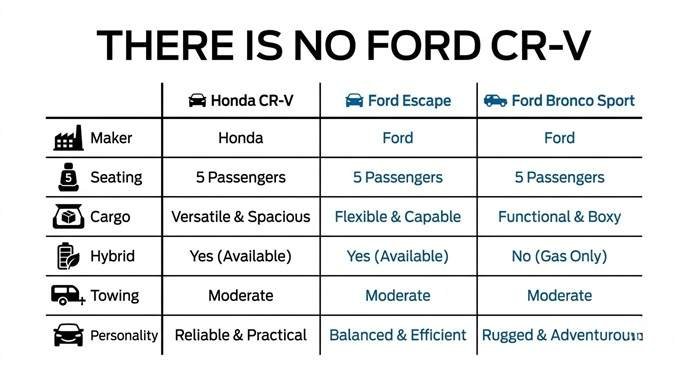
Frequently Asked Questions
Does Ford make a CR-V?
No. Honda makes the CR-V. Ford never sold a U.S. model under that name.
What is Ford’s version of the Honda CR-V?
There is no Ford version of the CR-V. The closest class rival has been the Ford Escape. Bronco Sport is Ford’s other compact SUV.
What Ford SUV is similar to the CR-V?
Escape for family compact-crossover duty. Bronco Sport for a smaller, more off-road compact Ford.
Is Ford Escape bigger than CR-V?
No. The current CR-V is generally longer and has more published cargo volume, especially seats-folded. Escape is a bit shorter and easier in some garages. Always compare the same model year.
Is the Ford Escape similar to the Honda CR-V?
Yes, in class: five seats, compact SUV, FWD or AWD, gas or hybrid in recent years, mainstream price. They differ in engines, towing, cargo cube, and interior design.
Does Ford make a CR-V Hybrid?
No. Honda makes the CR-V Hybrid. Ford’s comparable product was the Escape Hybrid.
Is there a Ford SUV like the CR-V Hybrid?
The Escape Hybrid was that vehicle. Bronco Sport is not a hybrid. Mach-E is electric, not a hybrid CR-V.
Is Honda CR-V better than Ford’s compact SUV?
Not as a blanket statement. The CR-V leads on rear-seat space, max cargo, hybrid reputation, and resale. A 2.0-liter Escape can tow more and feel stronger. Bronco Sport is more trail-capable and less family-roomy. Drive the ones that match your fuel type and seating need.
What Is the Ford CR-V?
Ford does not make a CR-V. Honda does. The ford crv search is almost always a compact-SUV shopper asking for Ford’s Honda CR-V rival. That rival has been the Ford Escape. If you cannot buy a new Escape in your model year, Ford’s compact SUV to test is the Bronco Sport, with a used Escape still filling the old CR-V-shaped hole in the lineup.
Honda CR-V: roomier cargo, stronger hybrid story, 1,500-pound towing. Ford Escape: same job, optional 250-hp engine, higher tow rating on the 2.0-liter. Bronco Sport: smaller, AWD, more dirt. None of them is a Ford CR-V — because that name belongs to Honda.
Before you put down a deposit, sit in a current CR-V and the Ford you were actually offered, on the same day, with a child seat if you use one. That test, not the search term, is the vehicle.
Related Post