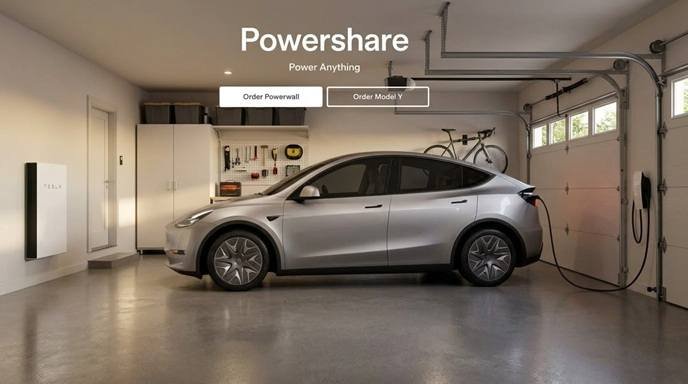
Tesla has quietly flipped the switch on a feature that many owners have been waiting years for. On October 6, 2026, the company activated Powershare Home Backup for the Model 3 and Model Y when paired with a Powerwall 3. This means these two best-selling Teslas can now send power back into your house during a blackout, extending your home’s backup duration by more than two days.
Until today, full vehicle-to-home (V2H) capability in the U.S. was limited to the Cybertruck. The new announcement marks the first time Tesla’s highest-volume models can act as a serious home backup power source.
The setup is straightforward if you already have (or are planning to add) a Powerwall 3. You plug your Model 3 or Model Y into a compatible Tesla Wall Connector or Universal Wall Connector. When the grid goes down, the car’s battery pack automatically feeds power into your home’s electrical system through the Powerwall.
Tesla estimates that a Model 3 or Model Y starting at 90% charge can add more than two days of backup power for a typical American household using about 30 kWh per day. Higher-trim Performance and Premium versions can push past that threshold. The system supports up to 11.52 kW of continuous output — enough to run most household appliances, including air conditioning and major electronics.
The feature is currently available only for vehicles ordered in the U.S. and Puerto Rico on or after October 1, 2026. Tesla’s fine print notes that “some, but not all” earlier Model 3 and Model Y vehicles have the necessary bidirectional hardware, but there is no official retrofit path for older cars.
For U.S. buyers, especially those in storm-prone regions like Florida, Texas, California, and the Southeast, this is a meaningful upgrade. A Powerwall 3 alone typically provides 13.5 kWh of usable energy. Adding a Model 3 or Model Y roughly doubles (or more) that capacity without needing a second or third Powerwall.
- Homes with frequent outages
- Off-grid or partially off-grid living
- People who want whole-home backup without the cost of multiple stationary batteries
Unlike portable generators, the system is silent, produces no emissions, and switches over automatically. It also works in tandem with solar panels, letting your car recharge from the sun during the day and power the house at night.
This is not a universal “any Tesla can do it” feature. Key requirements include:
- Powerwall 3 (Powerwall 2 support is expected later)
- Compatible Wall Connector
- A new Model 3 or Model Y ordered after October 1, 2026 (or certain earlier builds that happen to have the hardware)

Older Model 3 and Model Y vehicles without the bidirectional power electronics are still out of luck for full home backup. Vehicle-to-Load (V2L) adapters that power individual appliances remain limited to specific Model Y trims in the U.S.
Tesla is also years behind competitors. Ford’s F-150 Lightning and GM’s Silverado EV and Equinox EV have offered factory vehicle-to-home capabilities for several years. Tesla’s delay has been one of the most common complaints from owners who wanted their car to double as emergency home power.
The October 6 rollout shows Tesla is finally bringing its mass-market vehicles into the bidirectional era. As more new Model 3 and Model Y deliveries hit the road with this capability, the combination of a Tesla vehicle + Powerwall 3 becomes one of the most capable home energy systems available.
For American buyers ordering a new Model 3 or Model Y today, the ability to power your home is now part of the package — provided you also have (or add) a Powerwall 3. It turns your daily driver into a mobile battery that can keep the lights on, the fridge running, and the AC working during extended outages.
The feature is still rolling out, and Tesla has not yet confirmed exact timing for broader Powerwall 2 support or potential software updates for some existing vehicles. But for new buyers, the long wait is finally over.
In a country where power outages from storms, heat waves, and grid strain are increasingly common, Tesla’s move to equip its most popular cars with home backup capability is a practical win — even if it arrived later than many hoped.
Related Post