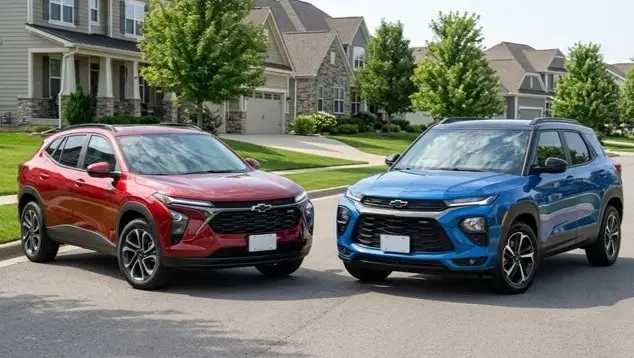
Smallest Chevy SUV 2026
Trax vs. Trailblazer — Size, Price & MPG Compared (Spoiler: “Smallest” Isn’t What You Think)
The Question Everyone Gets Wrong
Ask most shoppers which Chevy SUV is smaller, the Trax or the Trailblazer, and nearly everyone guesses Trax — it’s the cheaper, entry-level nameplate, so logic says it must be the smaller car. That assumption made sense for over a decade. It no longer does.
Both vehicles continue into 2026 with no major mechanical overhaul, carrying over their current generations with pricing adjustments and minor trim tweaks. This makes 2026 the perfect moment to settle the “which is actually smallest” question with real numbers rather than assumptions.
Quick Side-by-Side Snapshot
- 1.2L turbo-3, 137 hp, CVT
- FWD only — no AWD offered at all
- 28 city / 32 hwy / 30 combined MPG
- Length: 173.4 in | Wheelbase: 103.9 in
- Cargo: 25.6 cu ft rear / 54.1 cu ft max
- 11-inch touchscreen standard, all trims
- Lowest Price
- 1.2L turbo-3 (FWD) or 1.3L turbo-3 (AWD)
- AWD available — only one in the pair
- 29 city / 31 hwy / 30 combined MPG (FWD)
- Length: 173.6 in | Wheelbase: 101.2 in
- Cargo: 25.3 cu ft rear / 54.4 cu ft max
- 7-inch screen base, 11-inch on higher trims
- More Capable
Size Showdown: The Real Numbers
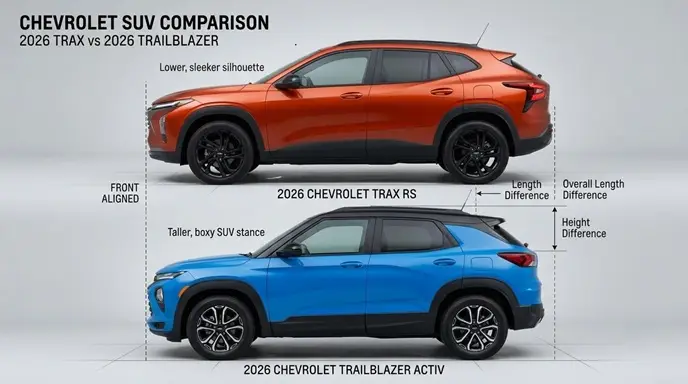
Here’s where the surprise lives. Overall length, the number most people use to judge “bigger vs. smaller,” is now nearly a dead heat — just two-tenths of an inch separate the two models, with the Trailblazer technically a hair longer. Meanwhile, the Trax has a noticeably longer wheelbase, which generally translates to more usable interior legroom relative to its footprint.
| Dimension | Trax | Trailblazer | Winner |
|---|---|---|---|
| Overall Length | 173.4 in | 173.6 in | Essentially tied |
| Wheelbase | 103.9 in | 101.2 in | Trax |
| Overall Width | 71.2 in | 69.9 in | Trax |
| Ground Clearance | ~6.0 in | ~7.0 in (Activ higher) | Trailblazer |
| Cargo (behind rear seat) | 25.6 cu ft | 25.3 cu ft | Trax |
| Max Cargo (seats folded) | 54.1 cu ft | 54.4 cu ft | Trailblazer |
| Seating Capacity | 5 | 5 | Tied |
In practical terms: the Trax is now the slightly wider, slightly roomier-feeling vehicle inside thanks to its longer wheelbase, while the Trailblazer holds a tiny edge in ground clearance and maximum cargo volume. Neither vehicle is dramatically “smaller” than the other anymore — the real differences between them live elsewhere.
Where They Actually Differ: Powertrain & Drivetrain
| Specification | Trax | Trailblazer |
|---|---|---|
| Standard Engine | 1.2L turbo I3, 137 hp, 162 lb-ft | 1.2L turbo I3, 137 hp, 162 lb-ft |
| Available Engine | Not offered | 1.3L turbo I3, 155 hp, 174 lb-ft (AWD trims) |
| Transmission | CVT (all trims) | CVT (FWD) or 9-speed auto (AWD) |
| All-Wheel Drive | Not available on any trim | Available on LT, Activ, RS |
| Combined MPG (FWD) | 30 mpg | 30 mpg (tied) |
| Combined MPG (AWD) | N/A | 28 mpg |
| Towing Capacity | Not rated for towing | Not rated for towing |
This is the single biggest functional difference between the two. The Trax is strictly front-wheel drive across every single trim — there is no AWD Trax at any price. If you live somewhere with real winters or want extra traction for light gravel roads, the Trailblazer is the only one of the two that can deliver it, and it does so with a more powerful 155-hp engine exclusive to its AWD trims.
2026 Trim-by-Trim Pricing
| Trax Trim | Est. Price | Trailblazer Trim | Est. Price |
|---|---|---|---|
| LS | $21,795 | LS | $23,400 |
| 1RS | $22,795 | — | — |
| LT | $23,595 | LT (FWD) | $24,600 |
| Activ | $24,495 | Activ (AWD avail.) | $26,600 |
| RS | $24,895 | RS (AWD avail.) | $26,900 |
Across every comparable trim level, the Trax undercuts the Trailblazer by roughly $1,600–$2,100, making it the clear choice for buyers whose top priority is the lowest possible out-the-door price. That gap widens further once you factor in that adding AWD to a Trailblazer pushes its price even higher — a cost the Trax can never incur because the option simply doesn’t exist.
Fuel Economy Deep Dive
In their most common front-wheel-drive configurations, the Trax and Trailblazer are essentially fuel-economy twins — both rated at 30 mpg combined thanks to sharing the same 1.2-liter turbo-three and CVT. Where they diverge is the moment you want AWD. The Trailblazer’s AWD models swap in the larger 1.3-liter engine and a conventional 9-speed automatic, which drops combined economy to around 28 mpg — still respectable, but a step down from the FWD version.
Because the Trax has no AWD option whatsoever, every Trax on the road delivers that same 30-mpg combined figure regardless of trim, giving it a slight real-world efficiency edge for buyers who were never going to choose AWD anyway.
Interior Technology
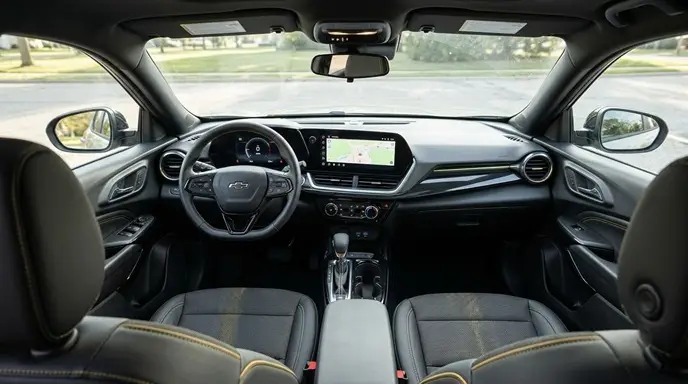
The Trax holds a meaningful tech advantage at the base-trim level. Chevrolet standardized an 11-inch diagonal infotainment touchscreen across the entire Trax lineup, meaning even the cheapest LS trim gets the same-sized display as the most expensive RS. The Trailblazer, by contrast, starts with a smaller 7-inch touchscreen on its base LS trim, with the larger 11-inch unit reserved for LT and higher trims — a notable gap for budget-focused shoppers comparing the two base models directly.
Both vehicles offer wireless Apple CarPlay and Android Auto, a configurable digital driver display on higher trims, and similar Chevy Safety Assist active-safety features as standard equipment.
Styling & Trim Personality
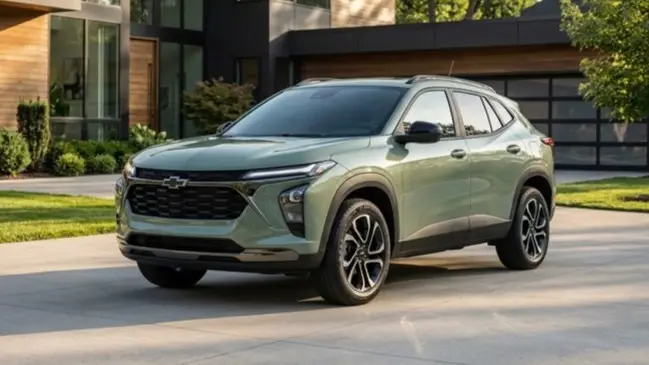
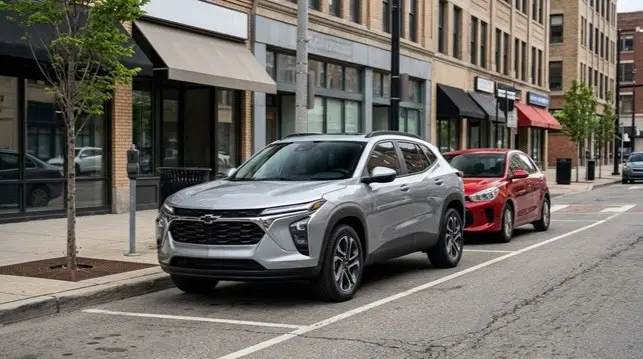
The Trax leans into a lower, more car-like crossover stance with its RS trim offering a sportier blacked-out aesthetic, while its Activ trim adds light off-road-styled cladding without any actual AWD hardware to back it up — a styling-only distinction worth knowing before you pay extra for the look.
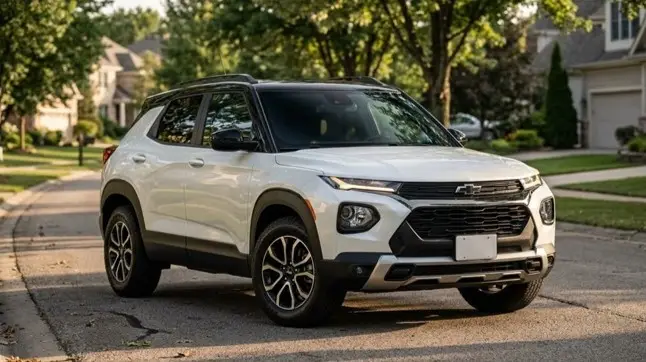
The Trailblazer’s Activ and RS trims follow a similar styling split (rugged-look vs. sport-look) but back the Activ trim’s higher ground clearance with genuinely available AWD, making its “adventure” positioning more substantive than the Trax equivalent.
Final Scorecard
Choose the Trax if…
You want the lowest possible price, don’t need AWD under any circumstance, and want the biggest infotainment screen available on the cheapest trim. It’s the better pick for budget-focused commuters and city drivers who never see snow or unpaved roads.
Choose the Trailblazer if…
You want the option of all-wheel drive, a more powerful engine on upper trims, slightly more ground clearance, and marginally more max cargo space — and you’re willing to pay roughly $1,600–$2,100 more for that flexibility.
Related Post